
You want to see both. The gorillas. And the chimpanzees. You’ve seen the documentaries. You’ve read the blogs. But can you really do both in one trip?
After 15 years and over 500 treks through Bwindi and Kibale, here’s the honest truth: Yes. And you should.
A 5-day gorillas and chimpanzees tour is not only possible—it is the single best way for a first-time visitor to experience Uganda’s primate wealth. You will spend one day trekking chimpanzees in Kibale Forest (2-4 hours, easier terrain). You will spend one day trekking mountain gorillas in Bwindi (2-6 hours, steeper, muddier). In between, you will drive through some of the most beautiful countryside on Earth. You will be tired. You will be muddy. You will be transformed.
This guide walks you through every moment of that 5-day journey—what you will see, what you will feel, what you will pay, and what no one tells you.
This is the only guide you need for planning a 5-day gorillas and chimpanzees tour in Uganda for 2026. It covers: a complete day-by-day itinerary (wake-up to lights-out), honest cost breakdowns (permits, transport, lodging, hidden costs), what each trek actually feels like (sensory details, not just logistics), fitness requirements, packing specifics, accommodation recommendations in both Kibale and Bwindi, how to handle the long driving days, and answers to every question first-timers ask. No fluff. No generic advice. Just the truth from someone who has done this hundreds of times.
Quick Overview of the 5-Day Journey
| Day | Activity | Location | Overnight |
|---|---|---|---|
| Day 1 | Arrive Entebbe, drive to Kibale (5-6 hours) | Kibale Forest | Kibale lodge |
| Day 2 | Chimpanzee trekking (AM), optional Bigodi swamp walk (PM) | Kibale Forest | Kibale lodge |
| Day 3 | Drive Kibale to Bwindi (6-7 hours) | Scenic drive | Bwindi lodge |
| Day 4 | Gorilla trekking (AM) | Bwindi Forest | Bwindi lodge |
| Day 5 | Drive Bwindi to Entebbe (7-8 hours), depart | Return | Home |
The deeper truth: Two treks. Two forests. Two completely different energies. The chimpanzees will move fast, scream loud, and remind you that we are not so far from the wild. The gorillas will sit still, stare deep, and remind you that we are not so different at all. Together, they will change how you see yourself. That is not marketing. That is what happens.
The 30-Second Answer – Is a 5-Day Primate Safari Right for You?
Before we dive into the day-by-day, here’s whether this trip fits your travel style.
Quick Fit Assessment
| If you… | Then this 5-day tour is… |
|---|---|
| Want to see both of Uganda’s iconic primates in one trip | The perfect choice |
| Have 5-7 days for Uganda (not just gorillas) | Ideal for your timeframe |
| Are moderately fit (can hike 3-6 hours on uneven terrain) | Very doable with porters |
| Don’t mind long driving days (5-7 hours between parks) | Part of the adventure |
| Want to maximize wildlife sightings in limited time | The most efficient use of your days |
| Prefer a relaxed, single-destination trip | Not for you (choose just gorillas) |
| Have serious mobility issues | Challenging (consider just one trek) |
| Want the most profound wildlife experience of your life | Unforgettable |
What Makes This Trip Special
The Gorilla-Chimpanzee Contrast:
| Chimpanzee Trekking (Kibale) | Gorilla Trekking (Bwindi) | |
|---|---|---|
| Energy | Fast, loud, chaotic, acrobatic | Slow, still, serene, powerful |
| Terrain | Moderate hills, established trails | Steep, muddy, dense vegetation |
| Trek duration | 2-4 hours (average 2-3) | 2-6 hours (average 3-4) |
| Time with primates | 1 hour | 1 hour |
| Distance | Can be 5-10m, sometimes closer | Minimum 7m (but may approach) |
| Emotional impact | Excitement, wonder, laughter | Awe, tears, silence |
| Physical demand | Moderate | Strenuous |
The Honest Truth: “A 5-day primate safari is not a relaxing vacation. It is an expedition. You will drive long hours. You will wake up early. You will hike until your legs shake. And then you will look into the eyes of a mountain gorilla, and you will understand why people call this the most profound wildlife experience on Earth. If you want a beach holiday, book Zanzibar. If you want to be changed, book this.”
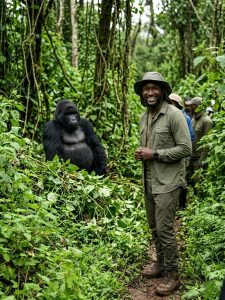
[IMAGE PLACEMENT 1: Split image – chimpanzee in Kibale (active, tree-swinging) vs gorilla in Bwindi (still, eye contact). 1200px+. Caption: “Two treks. Two energies. One unforgettable journey.”]
Complete 5-Day Itinerary – Wake-Up to Lights-Out
*Let me walk you through every moment of this 5-day journey. You will know exactly what to expect, from breakfast to tears.*
Day 1: Arrival and the Journey to Kibale
Morning (Arrival at Entebbe):
-
Your international flight lands at Entebbe International Airport (EBB)
-
Clear immigration, present yellow fever certificate, collect luggage
-
Meet your guide/driver (they will hold a sign with your name)
-
Briefing: final itinerary check, money exchange, SIM card purchase if needed
Midday (Drive to Kibale National Park):
-
Depart Entebbe for Kibale (approximately 5-6 hours driving)
-
Route: Entebbe → Kampala (bypass) → Mityana → Mubende → Fort Portal → Kibale
-
Stop for lunch en route (local restaurant or packed lunch)
-
Scenery changes from urban to rolling hills to tea plantations to forest
Afternoon (Arrive Kibale):
-
Check into your lodge (options below)
-
Rest, shower, prepare for tomorrow’s chimpanzee trek
-
Dinner at lodge (early night—tomorrow starts early)
Evening (What You’ll Feel):
-
Excitement mixed with travel fatigue
-
The air is cooler, fresher, forest-scented
-
Listen to the sounds of Kibale at night (you might hear chimpanzees calling)
The Honest Day 1 Truth: “The drive is long. You will be tired. But Fort Portal (near Kibale) is one of the most beautiful areas in Uganda—green, volcanic, tea-covered hills. Look out the window. The journey is part of the story.”
Day 2: Chimpanzee Trekking – The Fast, The Loud, The Wild
Morning (Chimpanzee Trek):
| Time | Activity | What to Expect |
|---|---|---|
| 5:30 AM | Wake up | Coffee/tea delivered to your room |
| 6:00 AM | Breakfast | Eat well—you need energy |
| 6:30 AM | Pack daypack | Water, snacks, camera, rain gear |
| 7:00 AM | Depart for park HQ | Short drive from lodge |
| 7:30 AM | Briefing at Kanyanchu Visitor Center | Rules, group assignment, guide introduction |
| 8:00 AM | Trek begins! | Enter Kibale Forest |
| 8:00 AM – 10:30 AM | Trekking | 1-3 hours through moderate terrain |
| 10:30 AM (approx) | Locate chimpanzees | Trackers radio ahead; you hear them before you see them |
| 10:30 AM – 11:30 AM | THE HOUR WITH CHIMPS | Screaming, swinging, eating, playing, mating, fighting |
| 11:30 AM | Trek back | 30-60 minutes to trailhead |
| 12:30 PM | Return to lodge | Shower, rest, lunch |
What the Chimpanzee Trek Actually Feels Like:
-
First sound: Screaming. Loud, chaotic, almost alarming. You will hear them before you see them.
-
First sight: Shapes moving fast through the canopy. Branches breaking. Leaves falling.
-
The hour: They do not sit still like gorillas. They move constantly. You will run, duck, scramble to keep up. Your guide will clear vegetation. You will be out of breath.
-
Emotional hit: Laughter. Wonder. Disbelief that these are your cousins—sharing 98.8% of your DNA.
Afternoon (Optional Bigodi Swamp Walk or Rest):
-
Option 1 (Recommended): Bigodi Wetlands Sanctuary (2-3 hours, $20-30). Guided walk through swamp boardwalks. See monkeys, birds, butterflies. Good for photography.
-
Option 2: Rest at lodge. Nap. Swim if pool available. Prepare for tomorrow’s drive.
Evening:
-
Dinner at lodge
-
Prepare bags for early departure to Bwindi tomorrow
-
Reflect on the chimpanzees (you will still hear them when you close your eyes)
The Honest Chimpanzee Truth: “The chimps will not sit for portraits like gorillas. They are chaos incarnate. And that chaos is exactly why you will love them. You are watching your ancient ancestors—unfiltered, unashamed, alive. It is humbling and hilarious at the same time.”
Day 3: The Great Drive – Kibale to Bwindi
Morning (Early Departure):
| Time | Activity |
|---|---|
| 6:00 AM | Wake up, breakfast |
| 7:00 AM | Depart Kibale for Bwindi |
| 7:00 AM – 1:00 PM | Driving (6-7 hours including stops) |
The Drive (What You’ll See):
-
Route: Kibale → Kasese (view of Rwenzori Mountains) → Queen Elizabeth NP border → Ishasha → Bwindi
-
Stop 1 (optional): Equator crossing (photo opportunity, $0)
-
Stop 2 (lunch): Town en route (local restaurant or packed lunch)
-
Stop 3 (wildlife, if lucky): Ishasha sector for tree-climbing lions (not guaranteed)
-
Scenery: Tea plantations → savanna grasslands → forested mountains → Bwindi
Afternoon (Arrive Bwindi):
-
Check into lodge (specific region depends on permit assignment: Buhoma, Ruhija, Rushaga, or Nkuringo)
-
Rest, shower, organize gear for tomorrow’s gorilla trek
-
Briefing from lodge staff or guide about tomorrow’s schedule
Evening:
-
Dinner at lodge (early night—gorilla trekking starts very early)
-
Double-check packing: gaiters? waterproof pants? boots broken in?
-
Nerves may start (this is normal)
The Honest Driving Truth: “Day 3 is the hardest day of the itinerary. Six to seven hours of driving after two days of travel and trekking. You will be tired. You will want to be there already. But this drive takes you through the most varied landscapes in Uganda—from volcanic craters to savanna to rainforest. Window seat. Camera ready. Embrace the road.”
Day 4: Gorilla Trekking – The Still, The Deep, The Transformative
Morning (Gorilla Trek):
| Time | Activity | What to Expect |
|---|---|---|
| 5:30 AM | Wake up | Lodge coffee/tea delivered |
| 6:00 AM | Breakfast | Eat well—you need energy |
| 6:30 AM | Pack daypack | Water, snacks, camera, rain gear (gaiters on) |
| 7:00 AM | Depart for park HQ | Short drive from lodge |
| 7:30 AM | Briefing at park HQ | Rules, group assignment (you don’t choose the family), guide introduction |
| 8:00 AM | Hire porter (DO THIS) | $15-20; best money you’ll spend |
| 8:15 AM | Drive to trailhead | Short drive or walk to starting point |
| 8:30 AM | Trek begins! | Into Bwindi Impenetrable Forest |
| 8:30 AM – 12:30 PM | Trekking | 2-5 hours through mud, steep slopes, dense vegetation |
| 12:30 PM (approx) | Locate gorillas | Trackers radio ahead; the silverback may be visible |
| 12:30 PM – 1:30 PM | THE HOUR WITH GORILLAS | Life-changing. Whisper. No flash. Tears likely. |
| 1:30 PM | Trek back | 30-90 minutes to trailhead |
| 2:30 PM | Return to lodge | Celebration! Shower. Nap. Elation. |
What the Gorilla Trek Actually Feels Like:
-
First sight: A shape in the vegetation. Dark. Massive. A silverback’s back.
-
First eye contact: Time stops. They look through you, not at you. You feel seen in a way you cannot explain.
-
The hour: They eat. They groom. Babies play. The silverback watches. You watch him watching you.
-
Emotional hit: Tears. Almost everyone. Not sadness. Overwhelm. Awe. The recognition that this being shares 98% of your DNA and is looking at you with quiet curiosity.
-
Afterward: Silence on the hike back. No one knows what to say. You are processing. You will be processing for weeks.
Afternoon (Rest and Celebration):
-
Shower (you will need it—mud everywhere)
-
Lunch at lodge
-
Nap (you will be exhausted)
-
Certificate presentation (you officially completed gorilla trekking)
-
Celebration drink (you earned it)
Evening:
-
Dinner (conversation will be about the gorillas)
-
Share photos with fellow trekkers
-
Early bed (you are tired in the best way)
The Honest Gorilla Truth: “The chimpanzees made you laugh. The gorillas will make you cry. Not because you are sad. Because you are in the presence of something so ancient, so powerful, so familiar, that your body doesn’t know what to do except release. Let it happen. Bring tissues.”
Day 5: Return to Entebbe – The Journey Home
Morning (Early Departure):
| Time | Activity |
|---|---|
| 6:00 AM | Wake up, breakfast |
| 7:00 AM | Depart Bwindi for Entebbe |
| 7:00 AM – 2:00 PM | Driving (7-8 hours including stops) |
The Drive Back:
-
Route: Bwindi → Kabale → Mbarara → Masaka → Entebbe
-
Stop 1 (optional): Lake Bunyonyi viewpoint (stunning, 15 minutes)
-
Stop 2 (lunch): Mbarara town (Ugandan roadside restaurant)
-
Stop 3 (shopping, if desired): Craft market en route for souvenirs
-
Scenery: Forest → rolling hills → terraced farmland → savanna → urban
Afternoon (Arrive Entebbe):
-
Drop-off at Entebbe International Airport
-
Check-in for international flight
-
Time to reflect: What just happened? You saw chimpanzees AND gorillas in 5 days.
Evening:
-
Flight departs (most flights are evening/overnight)
-
You will sleep on the plane replaying the hour with the gorillas
-
You will already be planning your return
The Honest Day 5 Truth: “The drive back is long. You are tired. Your legs hurt. Your heart is full. You will look out the window and see Uganda disappearing behind you. You will wonder if you will ever come back. (You will. Everyone does.)”
[IMAGE PLACEMENT 2: Day-by-day visual itinerary map showing the route from Entebbe → Kibale → Bwindi → Entebbe with icons. Caption: “5 days. 2 forests. 1,200 kilometers. One unforgettable journey.”]
Total Costs – What You’ll Actually Pay (Permits + Everything Else)
Let’s talk money. This trip is not cheap. But it is worth every dollar.
Complete Cost Breakdown (5-Day Private Tour, Mid-Range)
| Expense | Cost (per person) | Notes |
|---|---|---|
| Gorilla permit | $800 | Fixed, non-negotiable |
| Chimpanzee permit | $250 | Fixed, includes guide |
| Accommodation (4 nights mid-range) | $500 | $125/night average |
| Transport (private 4×4, 5 days) | $400-500 | Divided by group size |
| Meals (not included at all lodges) | $100 | Budget $20-25/day |
| Porter (gorilla trek) | $20 | Strongly recommended |
| Porter (chimp trek – optional) | $15-20 | Helpful but less necessary |
| Tips (guides, drivers, lodge staff) | $60-100 | Budget for this |
| Visa | $50 | E-visa required |
| Travel insurance | $50-150 | Required for medical evacuation |
| Gear rental (gaiters, etc.) | $20 | If not bringing your own |
| Miscellaneous (snacks, drinks, souvenirs) | $100 | Optional |
| TOTAL (approximate) | 2,400−2,800 | For one traveler |
Cost by Group Size (Shared Transport)
| Group Size | Cost per person (mid-range) |
|---|---|
| 1 solo traveler | 2,800−3,200 |
| 2 travelers | 2,200−2,500 each |
| 4 travelers | 1,900−2,200 each |
| 6 travelers | 1,800−2,000 each |
What You’re Paying For
The permits alone are 1,050(800 gorilla + $250 chimpanzee). That is non-negotiable.
The rest is accommodation, transport, and logistics. You can reduce costs by:
-
Choosing budget accommodation (50−80/nightinsteadof125)
-
Joining a group tour (shared transport, lower per-person cost)
-
Traveling in low season (April-May) for 20-40% accommodation discounts
The Honest Cost Truth: “This is not a budget trip. Two permits alone cost $1,050. But you are seeing two of the most extraordinary primate experiences on Earth in five days. Most travelers say it was the best money they ever spent. You will too.”
[IMAGE PLACEMENT 3: Cost breakdown infographic – pie chart showing permit costs vs accommodation vs transport. Caption: “Where your 2,500goes:1,050 in permits, the rest in comfort.”]
Chimpanzee Trekking vs Gorilla Trekking – What’s the Difference?
You will do both. Here is how they compare, moment by moment.
Side-by-Side Comparison
| Factor | Chimpanzee Trek (Kibale) | Gorilla Trek (Bwindi) |
|---|---|---|
| Permit cost | $250 | $800 |
| Success rate | 95%+ (habituated communities) | 98%+ |
| Trek duration | 2-4 hours | 2-6 hours |
| Terrain | Moderate hills, established trails | Steep, muddy, dense vegetation |
| Physical difficulty | Moderate | Strenuous |
| Porter recommended? | Helpful but optional | YES (strongly recommended) |
| Time with primates | 1 hour | 1 hour |
| Distance from primates | Can be 5-10m, sometimes closer | Minimum 7m (but may approach) |
| Behavior | Fast, loud, acrobatic, chaotic | Slow, still, serene, powerful |
| Photo difficulty | Challenging (they move constantly) | Moderate (they sit still) |
| Emotional tone | Excitement, wonder, laughter | Awe, tears, silence |
| Best for | Action lovers, photographers (with fast lens) | Anyone wanting profound connection |
What No One Tells You
About chimpanzee trekking:
-
You will hear them before you see them. The screaming is unsettling at first.
-
They do not pose. You will run to keep up.
-
You may see them mating, fighting, playing, grooming, eating.
-
The babies are absurdly cute and acrobatic.
-
You will laugh out loud multiple times.
About gorilla trekking:
-
The trek is harder. Accept this now.
-
The first eye contact will stop your breath.
-
You may cry. This is normal. Bring tissues.
-
The silverback’s presence is physically palpable.
-
You will be silent on the hike back. Processing.
The Honest Comparison Truth: “The chimpanzees are your wild cousins—chaotic, loud, hilarious. The gorillas are your wise grandparents—still, deep, powerful. You need both to understand the full spectrum of who we are.”
[IMAGE PLACEMENT 4: Split photo comparison – chimpanzee trekking (fast movement, forest canopy) vs gorilla trekking (close eye contact, dense vegetation). Caption: “Chimps: chaos. Gorillas: stillness. Both: unforgettable.”]
Where You’ll Stay – Accommodation in Kibale & Bwindi
You will spend four nights in lodges. Here is where to sleep in each forest.
Kibale Area Accommodation (2 nights)
| Lodge | Price Range | Vibe | Best For |
|---|---|---|---|
| Primate Lodge Kibale | $$$-$$$$ | Luxury in the forest; treehouse rooms | Honeymooners, luxury travelers |
| Kibale Forest Camp | $$-$$$ | Tented camp, close to park HQ | Mid-range, adventurous |
| Chimpanzee Forest Guesthouse | $-$$ | Budget, simple, clean | Backpackers, budget travelers |
| Papaya Lake Lodge | $$$-$$$$ | Stunning lake views near crater lakes | Romance, relaxation |
What to know about Kibale lodges:
-
Most are within 10-30 minutes of the Kanyanchu visitor center
-
Electricity and hot water are generally reliable
-
Wi-Fi may be limited (enjoy the digital detox)
-
Listen at night—you may hear chimps calling
Bwindi Area Accommodation (2 nights)
By region (depends on your gorilla permit assignment):
Buhoma Region (most accessible):
| Lodge | Price Range | Vibe |
|---|---|---|
| Buhoma Lodge | $$$-$$$$ | Luxury, stunning views |
| Bwindi View Bandas | $-$$ | Budget, basic, great location |
| Engagi Lodge | $$$ | Mid-range luxury |
Ruhija Region (moderate-challenging):
| Lodge | Price Range | Vibe |
|---|---|---|
| Ruhija Gorilla Lodge | $$-$$$ | Mid-range, great value |
| Bakiga Lodge | $$-$$$ | Popular, excellent food |
Rushaga Region (challenging, most families):
| Lodge | Price Range | Vibe |
|---|---|---|
| Rushaga Gorilla Camp | $-$$ | Budget to mid-range, popular |
| Gorilla Valley Lodge | $$-$$$ | Mid-range, good value |
Nkuringo Region (very challenging, spectacular views):
| Lodge | Price Range | Vibe |
|---|---|---|
| Clouds Mountain Gorilla Lodge | $$$$ | Ultra-luxury, life-changing views |
The Honest Accommodation Truth: “You are in remote rainforests. Do not expect the Four Seasons. Expect hot water (usually), good food (usually), and the sounds of the forest at night. The gorillas and chimpanzees are the luxury. The lodges are where you recover.”
[IMAGE PLACEMENT 5: Gallery – Primate Lodge Kibale (forest setting) and Clouds Mountain Gorilla Lodge (mountain views). Caption: “From Kibale’s forest canopy to Bwindi’s mountain heights.”]
What to Pack for Both Treks – The Complete Checklist
Pack for mud. Pack for rain. Pack for steep hills. Here is exactly what you need.
The Non-Negotiable Packing List for Both Treks
| Category | Item | Why You Need It |
|---|---|---|
| Footwear | Waterproof hiking boots (broken in!) | Both treks require serious footwear |
| Thick wool socks (3+ pairs) | Your feet WILL get wet | |
| Gaiters (ESSENTIAL for gorillas) | Keeps mud out of boots | |
| Clothing | Long waterproof pants | Bwindi is muddy even in dry season |
| Quick-dry hiking pants (not jeans) | For chimp trek and evenings | |
| Moisture-wicking base layer | Regulates temperature | |
| Long-sleeved shirt (neutral colors) | Protection from stinging nettles | |
| Fleece or light jacket | Mornings are cold (especially Bwindi) | |
| Waterproof rain jacket | Essential for both treks | |
| Gardening gloves | Protection from branches and nettles | |
| Gear | Daypack (20-30L) | For water, snacks, camera, layers |
| Water bottles (2L total) | Hydration is critical | |
| Snacks (energy bars, nuts) | Treks can run long | |
| Headlamp with extra batteries | Lodges may have limited electricity | |
| Power bank | Charging may be limited | |
| Camera with extra batteries | You will take hundreds of photos | |
| Health | Insect repellent (DEET or Picaridin) | Mosquitoes (malaria risk in both areas) |
| Sunscreen and hat | Sun is intense at altitude | |
| Personal medications | Bring enough for trip + extra | |
| Pain relievers (ibuprofen) | You will be sore | |
| Hand sanitizer | No soap on trail | |
| Tissue/wipes | No bathroom facilities on trail | |
| Documents | Passport (valid 6+ months) | Required |
| Visa (printed) | Required | |
| Yellow fever certificate | Required; cannot enter without | |
| Permit confirmations (printed + digital) | Rangers will check both permits | |
| Travel insurance documents | Required | |
| Money | USD cash (crisp bills, post-2020) | Tips, porters, emergencies |
| UGX for small purchases | Local markets, small tips |
What NOT to Pack
| Item | Why Not |
|---|---|
| Jeans | Heavy, cold, uncomfortable when wet |
| White or bright clothing | Primates need neutral colors |
| Expensive jewelry | Unnecessary risk |
| Drone | Illegal in national parks |
| Plastic bags | Banned in Uganda |
Portable Packing Checklist (Copy this)
☐ Waterproof hiking boots (broken in)
☐ Gaiters (non-negotiable for gorillas)
☐ 3+ pairs wool hiking socks
☐ Waterproof rain jacket
☐ Long waterproof pants
☐ Quick-dry hiking pants (2 pairs)
☐ Moisture-wicking base layer (top + bottom)
☐ Long-sleeved shirts (neutral colors, 2)
☐ Fleece or light jacket
☐ Gardening gloves
☐ Daypack (20-30L)
☐ 2L water capacity (bottles or bladder)
☐ Snacks (energy bars, nuts)
☐ Headlamp + extra batteries
☐ Power bank
☐ Camera + extra batteries + memory cards
☐ Insect repellent
☐ Sunscreen + hat
☐ Personal medications + pain relievers
☐ Hand sanitizer + tissues
☐ Passport (valid 6+ months)
☐ Visa (printed)
☐ Yellow fever certificate
☐ Both permit confirmations (printed + digital)
☐ Travel insurance documents
☐ USD cash (crisp, post-2020, $300-500)
☐ UGX cash (small amount)
The Honest Packing Truth: “Gaiters and waterproof pants are not optional for gorilla trekking. Every first-timer who skips them regrets it. Rent them in Bwindi if you don’t want to buy. Also: break in your boots before you arrive. Blisters on the trail are miserable. Blisters during TWO treks? Nightmare.”
[IMAGE PLACEMENT 6: Packing collage – boots, gaiters, rain jacket, daypack, gloves, socks. Caption: “These items separate the comfortable trekker from the miserable one.”]
Fitness & Difficulty – Can You Do Both Treks?
Be honest with yourself about your fitness. Here is what both treks demand.
Difficulty Assessment
| Fitness Level | Chimpanzee Trek (Kibale) | Gorilla Trek (Bwindi) | Combined 5-Day |
|---|---|---|---|
| Regular hiker (5-10 miles/week) | Easy | Moderate | Very doable |
| Moderately active (gym/walking 2-3x/week) | Moderate | Moderate-strenuous | Doable with porters |
| Sedentary (little regular exercise) | Moderate-challenging | Strenuous | Challenging but possible with porters |
| Serious mobility issues | Challenging | Very challenging | Not recommended |
What Makes Each Trek Hard
Chimpanzee Trek (Kibale):
-
Terrain: Moderate hills, established trails, less mud than Bwindi
-
Duration: 2-4 hours total
-
Challenge: Chimps move fast. You will be running, ducking, scrambling to keep up.
-
Porter value: Helpful but less essential than for gorillas
Gorilla Trek (Bwindi):
-
Terrain: Extremely steep, muddy even in dry season, dense vegetation
-
Duration: 2-6 hours total
-
Challenge: The mud is slippery. The elevation changes are punishing. The altitude is real (1,600-2,600m).
-
Porter value: ESSENTIAL. Do not skip.
Training Recommendations
If you have 4-6 weeks before your trip:
-
Walk 3-4 times per week, gradually increasing to 2-3 hours
-
Practice on uneven ground (trails, hills, stairs)
-
Wear your hiking boots to break them in
-
Do stairs (lots of stairs) – Bwindi is steep
If you have 2-3 weeks before your trip:
-
Walk daily (even 30 minutes helps)
-
Focus on stairs and hills
-
Break in boots as much as possible
If you leave tomorrow:
-
Hire porters for both treks
-
Go slow. No shame in being last.
-
Listen to your body. Take breaks.
The Porter Difference – Explained Again
For gorilla trekking (Bwindi):
-
Cost: $15-20
-
What they do: Carry your daypack (5-10kg). Pull you up steep sections. Push you when tired. Clear vegetation. Find footing in mud.
-
Verdict: Every client who hires a porter is grateful. Every client who doesn’t wishes they had.
For chimpanzee trekking (Kibale):
-
Cost: $15-20
-
What they do: Carry daypack. Help on moderate slopes.
-
Verdict: Less essential than for gorillas, but still helpful—especially if you are less fit or carrying camera gear.
The Honest Fitness Truth: “You don’t need to be an athlete. I have guided 70-year-olds who completed both treks. But you cannot be completely sedentary. Practice walking. Do stairs. And for the gorilla trek especially, hire a porter. That $20 is the difference between suffering and savoring.”
[IMAGE PLACEMENT 7: Difficulty infographic – terrain icons, elevation profiles, porter photos. Caption: “Chimps: moderate. Gorillas: strenuous. Porters: essential.”]
Health, Safety & Insurance – Don’t Skip This
Uganda is safe. But you need to prepare. Here is what you absolutely must do before both treks.
Required Health Preparations
| Requirement | Details | Deadline |
|---|---|---|
| Yellow fever vaccine | MANDATORY. Proof required at immigration. | At least 10 days before travel |
| Malaria prophylaxis | Strongly recommended for both Kibale and Bwindi | Begin before travel; consult doctor |
| Routine vaccines | Typhoid, hepatitis A, tetanus, polio | Weeks before travel |
Safety in Uganda
For tourists: Uganda is very safe. Both Kibale and Bwindi are heavily patrolled. Violent crime against tourists is extremely rare.
Common sense precautions:
-
Don’t walk alone at night in cities
-
Keep valuables secure
-
Use registered tour operators
-
Listen to your guide (they know the forest)
Travel Insurance – NOT Optional
Why you absolutely need it:
-
Medical evacuation from Bwindi costs $50,000+
-
Trekking injuries (twisted ankles, falls) happen on both treks
-
Trip cancellation protects your $1,050 in permit investments
What your policy MUST cover:
-
Medical evacuation (minimum $100,000 coverage)
-
Trekking/hiking at altitude (2,500m+ for gorillas)
-
Trip cancellation/interruption
-
Emergency medical expenses
The Honest Health Truth: “The biggest risks are twisted ankles and malaria (if you skip prophylaxis). Both are manageable. Get the insurance. Take the meds. Listen to your body. And bring pain relievers—you will need them after two treks.”
Photography – Capturing Both Experiences
You will want to remember both treks. Here is how to photograph each one.
Camera Gear Recommendations
| Experience Level | Chimpanzee Trek (Fast) | Gorilla Trek (Still) |
|---|---|---|
| Smartphone only | Challenging (they move fast) | Works well (portrait mode) |
| Enthusiast | Mirrorless with 70-200mm, fast autofocus | Same lens works well |
| Pro | 100-400mm, burst mode, fast shutter | 70-200mm f/2.8 ideal |
Camera Settings for Each Trek
Chimpanzee Trek (Kibale):
| Setting | Recommendation |
|---|---|
| Mode | Shutter Priority (S/Tv) or Manual |
| Shutter speed | Minimum 1/500s to freeze movement |
| Aperture | Wide (f/2.8 – f/5.6) |
| ISO | Auto (up to 6400) |
| Focus | Continuous AF (tracking) |
| Drive mode | Burst/continuous (shoot in bursts) |
Gorilla Trek (Bwindi):
| Setting | Recommendation |
|---|---|
| Mode | Aperture Priority (A/Av) |
| Shutter speed | Minimum 1/250s (1/400s for babies) |
| Aperture | f/2.8 – f/5.6 |
| ISO | Auto (up to 3200-6400) |
| Focus | Continuous AF (eye tracking if available) |
Ethical Photography Rules (Both Treks)
| Rule | Why |
|---|---|
| No flash | Disturbs both chimps and gorillas |
| Minimum distance | 7m for gorillas, 5-10m for chimps |
| No sudden movements | Primates may perceive as threat |
| Listen to guide | They may tell you to move or stop |
| No eating/drinking | Food attracts primates |
The Honest Photography Truth
“Chimpanzees are MUCH harder to photograph than gorillas. They move constantly. You will miss shots. Accept this now. For gorillas, they sit still. You have time. The best advice for both: spend some of your hour just watching. Put the camera down. Be present. The photos are souvenirs. The memory is what lasts.”
Frequently Asked Questions – 5-Day Gorilla & Chimp Tour
These are the questions I answer most often about combining both treks.
General Questions
Is 5 days enough for both gorillas and chimpanzees?
Yes. It is tight but doable. Day 1 and Day 5 are mostly driving. Days 2 and 4 are the treks. Day 3 is the transfer day.
Will I be too tired to enjoy both?
You will be tired. But the excitement carries you. Most travelers say they were exhausted but would do it again.
Which trek should I do first?
Chimps first (Day 2), then gorillas (Day 4). The chimp trek is physically easier and less emotionally overwhelming. Gorillas are the grand finale.
Can I add a second gorilla trek?
Yes. Add an extra day in Bwindi (Day 5 becomes second trek, Day 6 return to Entebbe).
Can I do both treks in one day?
No. The parks are 6-7 hours apart. Not possible.
Logistics Questions
How much driving is involved?
Approximately 5-6 hours Day 1, 6-7 hours Day 3, 7-8 hours Day 5. Total driving: 18-21 hours over 5 days.
Is the drive scenic?
Yes. Day 1 (Entebbe to Kibale) passes through tea plantations. Day 3 (Kibale to Bwindi) passes the Rwenzori Mountains and Ishasha. Day 5 (Bwindi to Entebbe) passes Lake Bunyonyi and rolling hills.
Can I fly between parks?
No direct flights between Kibale and Bwindi. Driving is the only practical option.
Do I need a different visa for both parks?
Same e-visa covers both. Apply for “Gorilla Trekking” visa (50)orTouristvisa(50).
Money Questions
How much does the 5-day tour cost?
2,400−2,800 for solo travelers; 1,900−2,200 per person for couples/groups.
Are permits refundable?
No. Non-refundable. Book when dates are confirmed.
Can I book this myself or need a tour operator?
You can DIY, but logistics are complex (two permits, two parks, long drives, two lodges). Most first-timers use a tour operator for peace of mind.
Physical Questions
Which trek is harder?
Gorilla trekking is significantly harder than chimpanzee trekking. Bwindi is steeper, muddier, and higher altitude.
Do I need to be fit for the chimp trek?
Moderate fitness is fine. The terrain is easier than Bwindi.
Can I hire porters for both?
Yes. Highly recommended for gorillas. Helpful but optional for chimps.
What if I can’t finish a trek?
Porters and guides will help. In extreme cases, you may turn back. Very rare for chimp trek. Possible for gorilla trek if fitness is very low.
The Final FAQ Truth
“Still nervous? That is normal. Combining two treks in five days is ambitious. But thousands of travelers do it every year. You can too. The key: porters, good boots, and a sense of adventure.”
Your 5-Day Planning Checklist – Ready to Book?
-
Permits: I have confirmed gorilla (800)andchimpanzee(250) availability for my dates
-
Budget: I have budgeted 2,400−2,800 total (or 1,900−2,200 if sharing)
-
Fitness: I am moderately fit and/or have committed to hiring porters for both treks
-
Packing: I have (or will rent) gaiters, waterproof pants, broken-in boots
-
Health: I have scheduled yellow fever vaccine, malaria prophylaxis, and travel insurance
-
Visa: I have applied for or will apply for e-visa
-
Accommodation: I have booked lodges in Kibale (2 nights) and Bwindi (2 nights)
-
Transport: I have arranged private 4×4 for all transfers
-
Cash: I have budgeted $300-500 for tips, porters, emergencies
-
Expectations: I am ready for long drives, early mornings, and profound moments
-
I am ready to book with confidence
The Peak – What 15 Years and 500 Treks Has Taught Me About Doing Both
Here is what 15 years and 500 treks through Kibale and Bwindi has taught me about combining chimpanzees and gorillas:
You need both to understand who you are.
The chimpanzees show you your wildness. The screaming. The movement. The chaos. The way they fight and play and eat without shame. They are your ancestors, unfiltered. Watching them, you recognize something familiar—something you keep locked away in your civilized cage.
The gorillas show you your stillness. The silence. The patience. The way the silverback watches his family with quiet authority. The way the mother holds her baby. Watching them, you recognize something even deeper—the part of you that knows how to be still, how to watch, how to protect.
Together, they complete something in you.
I have watched hundreds of travelers finish this 5-day journey. They arrive anxious, overwhelmed, unsure.
They leave quiet. Full. Already planning when they will come back.
You will too.
So here is my advice:
Book the trip. Do both treks. Hire the porters. Bring the gaiters. Eat the roadside lunch. Wake up at 5 AM. Hike until your legs shake. And when the silverback looks into your eyes, do not look away.
That moment will stay with you longer than any sore muscle.
The forests are waiting. The chimpanzees are screaming. The gorillas are watching.
Go.
Your Next Step
You have read the complete guide now. Itinerary. Costs. Packing. Fitness. Photography. FAQs.
But reading is not the same as booking. And booking is the only thing standing between you and two hours that will change how you see yourself.
At Travel Giants Uganda, we have guided over 500 treks in both Kibale and Bwindi. We have built this 5-day itinerary hundreds of times. We know exactly what works—and what does not.
Ready to stop planning and start going?
Email us at info@travelgiantsuganda.com with:
-
Your preferred travel dates (or flexibility)
-
Your group size
-
Your budget range
-
Any specific questions still on your mind
We will check permit availability for both parks, recommend lodges for each night, arrange private transport, and walk you through every step. No pressure. No hidden fees. Just honest help from people who have done this hundreds of times.
The chimpanzees will scream for you. The gorillas will watch for you. And you will come home different.
Let us make it happen.
Published for 2026 travel planning. Last updated: January 2026.
