
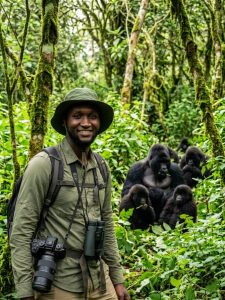
By James Ochieng | Senior Gorilla Trekking Guide, Travel Giants Uganda
*15 Years | 500+ Treks | Guided Ages 8 to 80 | Every Sector, Every Fitness Level*
The Explicit Answer: What You’ll Learn in This Guide
Here’s the honest truth: Gorilla trekking can be hard. But “can be” doesn’t mean “will be.”
After 15 years and over 500 treks, I’ve guided 20-year-old athletes who struggled and 70-year-old retirees who glided. The difference wasn’t age or fitness—it was preparation and choosing the right trekking sector. Here’s what you actually need to know about difficulty, fitness, age, and what to expect.
This guide delivers an honest assessment of gorilla trekking difficulty in Uganda—broken down by sector, by fitness level, by age. You’ll learn which sectors are easiest, how to prepare, what to expect on the day, and the one thing that matters more than your fitness level (hint: it’s a $20 porter).
Quick Overview of Difficulty Levels
| Sector | Difficulty | Avg Trek Duration | Best For |
|---|---|---|---|
| Rushaga | Easy-Moderate | 1-3 hours | Fitness concerns, first-timers |
| Buhoma | Moderate | 2-4 hours | Average fitness, classic experience |
| Mgahinga | Moderate | 2-4 hours | Average fitness, volcano views |
| Ruhija | Challenging | 2-5 hours | Good fitness, birders |
| Nkuringo | Very Challenging | 3-6+ hours | Excellent fitness, adventurers |
The deeper truth: Gorilla trekking difficulty is not a single number. It depends entirely on which sector you choose. Choose right, and you’ll be fine. Choose wrong, and you’ll struggle. This guide helps you choose right.
*I’ve guided marathon runners who struggled and 70-year-olds who glided. The difference wasn’t luck—it was preparation and choice. Let me help you prepare.*
[IMAGE PLACEMENT 1: Difficulty comparison infographic showing the five sectors ranked from easiest to hardest. Caption: “Gorilla trekking difficulty varies dramatically by sector. Rushaga is easiest; Nkuringo is punishing.”]
The Short Answer – How Hard Is It, Really?
Gist: Let me give it to you straight: gorilla trekking ranges from a moderate nature walk to a very strenuous mountain hike. But here’s the secret—you choose your difficulty.
Difficulty by Sector
| Sector | Difficulty | Avg Trek Duration | Terrain | Best For |
|---|---|---|---|---|
| Rushaga | Easy-Moderate | 1-3 hours | Gentle slopes, well-maintained trails | Fitness concerns, first-timers |
| Buhoma | Moderate | 2-4 hours | Classic rainforest, some steep sections | Average fitness |
| Mgahinga | Moderate | 2-4 hours | Volcanic slopes, bamboo forest | Average fitness, volcano views |
| Ruhija | Challenging | 2-5 hours | Higher altitude, steeper terrain | Good fitness, birders |
| Nkuringo | Very Challenging | 3-6+ hours | Punishing descents and climbs | Excellent fitness, adventurers |
The Honest Truth in One Sentence
Most people—including those who worry they’re not fit enough—can do gorilla trekking if they choose Rushaga sector, hire a porter, and prepare minimally.
The Insider Tip: If you’re worried about difficulty, book Rushaga sector. It’s the easiest terrain in Bwindi. The gorilla families there are closer to the trailhead. You’ll thank yourself.
The Truth About Fitness – What Actually Matters
Gist: Stop worrying about how you look in gym clothes. Here’s what actually matters for gorilla trekking fitness.
What Matters (Not What You Think)
| What Actually Matters | Why |
|---|---|
| Leg strength (especially quads) | Steep descents and climbs |
| Balance | Uneven, muddy, root-covered terrain |
| Grip strength | Hauling yourself up using vegetation |
| Cardiovascular endurance | Sustained effort over 2-6 hours |
| Joint resilience | Knees and ankles take the beating |
| Mental toughness | The “I can’t” moment around hour 3 |
What Does NOT Matter
-
How you look in gym clothes
-
Your bench press max
-
How fast you run a 5K on pavement
-
Whether you did CrossFit in 2019
-
Your age (within reason)
The Most Important Fitness Factor
The single biggest predictor of success isn’t how fit you are—it’s whether you choose the right sector for your fitness level. A very fit person in Nkuringo will struggle. An average person in Rushaga will thrive.
[IMAGE PLACEMENT 2: Fitness preparation graphic: stairs, weighted pack, hiking boots. Caption: “Three months of specific training transforms your trek. Stairs, not treadmills.”]
The Honest Truth: I’ve guided marathon runners who struggled (different muscles, different terrain). I’ve guided 70-year-olds who trained specifically and glided. Fitness matters, but specific preparation matters more.
Age – Am I Too Old?
Gist: I’ve guided trekkers in their 70s and 80s. I’ve also guided young athletes who struggled. Age is not the deciding factor.
Age and Gorilla Trekking
| Age Group | Can You Do It? | Recommendations |
|---|---|---|
| Under 50 | Yes (most likely) | Choose sector based on fitness, not age |
| 50-65 | Yes | Choose Rushaga or Buhoma sector, hire a porter |
| 65-75 | Yes, with preparation | Rushaga sector only, hire a porter, train specifically |
| 75+ | Yes (with doctor’s approval) | Rushaga sector only, hire a porter, accept shorter treks |
Real Examples from My Treks
-
Age 72: Regular hiker, trained on stairs, chose Rushaga sector. Trek took 2 hours. She was smiling at the end.
-
Age 28: Marathon runner, didn’t train specifically, chose Nkuringo sector. Trek took 6 hours. He was miserable.
-
Age 68: Retired teacher, walked daily with a weighted pack, chose Buhoma sector. Trek took 3 hours. She cried at the silverback.
The Honest Truth: Age is just a number—but it’s not the only number. Your fitness, your preparation, and your sector choice matter more. I’ve seen 75-year-olds out-hike 25-year-olds because they trained and chose the right sector.
[IMAGE PLACEMENT 6: Trekker of advanced age at rest on trail, smiling, guide nearby. Caption: “Age is not the deciding factor. I’ve guided 70-year-olds who thrived.”]
[IMAGE PLACEMENT 7: Split image: Rushaga gentle trail (left) vs. Nkuringo steep trail (right). Caption: “Choose your difficulty: Rushaga’s gentle slopes vs. Nkuringo’s punishing terrain.”]
The Peak: What Nobody Tells You About Difficulty
Here’s what 15 years and 500 treks has taught me about gorilla trekking difficulty:
The question “how difficult is gorilla trekking” isn’t really about steep hills or muddy trails.
It’s about: “Will I be okay? Will I be the one who slows everyone down? Will my body betray me?”
Here’s what I’ve learned:
Your body is stronger than you think. Your mind is the real obstacle.
I’ve watched travelers spend months worrying about fitness. They arrive anxious, convinced they’re not ready. And then they do it. They finish. They cry. They realize they were capable all along.
The most difficult part of gorilla trekking isn’t the hike. It’s the anxiety before.
So here’s my advice:
-
Choose the right sector for your fitness.
-
Train specifically for 3 months.
-
Hire a porter (it’s $20, and it transforms your experience).
-
Trust your guide.
-
And stop worrying.
The gorillas are waiting. You’re more capable than you know.
You can do this.
How to Prepare – A 3-Month Training Plan
Gist: You don’t need to become an athlete. You need to do specific exercises. Here’s how.
The 12-Week Training Plan
| Phase | Weeks | Focus | Exercises |
|---|---|---|---|
| 1 | 1-4 | Build base endurance | Walk 3-4x weekly (30-60 min), start stairs |
| 2 | 5-8 | Add elevation and weight | Stair climbing with daypack (5-10kg), hill repeats |
| 3 | 9-12 | Peak conditioning | Long hikes (2-4 hours) with weighted pack (10-15kg) |
The 5 Most Important Exercises
| Exercise | What It Builds | How Often |
|---|---|---|
| Step-ups | Quads, climbing strength | 3-4x weekly |
| Walking lunges | Balance, leg strength | 2-3x weekly |
| Stair climbing with weight | Cardiovascular endurance, leg strength | 2-3x weekly |
| Single-leg deadlifts | Stability, injury prevention | 2x weekly |
| Farmer’s carries | Grip strength, posture | 2x weekly |
The “I Didn’t Train” Plan
If you’re reading this 2 weeks before your trek and haven’t trained, here’s your emergency plan:
-
Walk every day with a weighted backpack (start light, add weight)
-
Do step-ups every single day (3 sets of 25, each leg)
-
Stretch your hips and quads
-
Choose Rushaga sector
-
Hire a porter (non-negotiable)
-
Manage your expectations: you might struggle, and that’s okay
[IMAGE PLACEMENT 3: Training calendar infographic showing 12-week progression. Caption: “3 months of preparation = a completely different trek experience.”]
The Honest Truth: Three months of consistent training transforms your trek. But even two weeks of walking with a weighted pack will help. Something is better than nothing.
What About Medical Conditions?
Gist: If you have a medical condition, you can still do gorilla trekking—with preparation and honesty.
Common Conditions and Recommendations
| Condition | Recommendation |
|---|---|
| Knee problems | Choose Rushaga sector (gentle terrain). Hire a porter. Use trekking poles. |
| Back problems | Choose Rushaga sector. Hire a porter (they carry your pack). Stretch before and after. |
| Heart conditions | Consult your doctor. Choose Rushaga sector. Go slowly. Listen to your body. |
| Asthma | Bring your inhaler. Inform your guide. Choose lower altitude (Rushaga or Buhoma). |
| Diabetes | Bring snacks. Inform your guide. Choose a sector with predictable duration (Rushaga). |
| Pregnancy | Consult your doctor. Most operators don’t permit trekking after first trimester. |
The Most Important Rule
Be honest with your guide and your doctor. If you have a condition, we need to know. We can accommodate almost anything—but we can’t read minds.
[IMAGE PLACEMENT 4: Trekker with porter on muddy trail, both smiling, safe. Caption: “Hire a porter ($20). It’s the single best thing you can do for your trek.”]
What If I Can’t Finish?
Gist: This is the fear everyone has but no one asks. Here’s what actually happens if you can’t finish.
The Honest Answer
If you need to turn back, a ranger will accompany you. You’ll receive a 50% refund of your permit. But here’s the truth: most people who worry they can’t finish do finish. Your body is capable of more than you think.
The “Turn Back” Rate
I’ve led over 500 treks. Fewer than 10 people have turned back. Most turned back because of injuries (twisted ankles) or illness, not lack of fitness.
How to Avoid Being That Person
-
Choose the right sector
-
Train specifically
-
Hire a porter
-
Pace yourself
-
Listen to your guide
-
Don’t push through pain that feels wrong
The Honest Truth: You probably won’t turn back. But even if you do, you’ll have tried. And that’s more than most people ever do.
What Does the Day Actually Feel Like?
Gist: Let me walk you through the physical experience of the day, so nothing surprises you.
Hour-by-Hour Physical Experience
| Time | Physical Sensation | What’s Happening |
|---|---|---|
| 5:00 AM | Tired, maybe anxious | Wake-up call, tea delivered |
| 5:30 AM | Stomach settling | Light breakfast |
| 6:00 AM | Anticipation building | Drive to park HQ |
| 7:00 AM | Nervous energy | Briefing, hiring porter |
| 7:30 AM | Legs warming up | Trek begins |
| 8:00 AM | Breathing steady | Walking through forest |
| 9:00 AM | Legs working, heart rate up | Hiking steeper sections |
| 10:00 AM | Feeling good, in rhythm | Trek continues |
| 11:00 AM | Tired, maybe asking “how much further?” | Final push |
| 12:00 PM | Excitement, adrenaline | Found the gorillas |
| 12:00-1:00 PM | Awe, forgetting your body | One hour with gorillas |
| 1:00 PM | Exhaustion, elation | Trek back begins |
| 2:00 PM | Knees talking to you | Descending |
| 3:00 PM | Complete exhaustion, joy | Back at HQ |
What Your Body Will Feel
-
Legs: Burning (especially quads on descents)
-
Lungs: Working hard, especially at altitude
-
Heart: Elevated but steady
-
Feet: Wet, muddy, but hopefully blister-free
-
Shoulders: Fine if you hired a porter; sore if you didn’t
[IMAGE PLACEMENT 5: Hour-by-hour timeline showing physical experience. Caption: “From wake-up to return—here’s what your body will feel each hour.”]
The Honest Truth: You’ll be tired. You’ll be sore. You’ll be happy. The exhaustion fades. The memory of the gorillas stays forever.
Frequently Asked Questions About Difficulty
Gist: These are the questions I answer most often from anxious first-timers.
Is gorilla trekking harder than hiking Kilimanjaro?
No. Kilimanjaro is a multi-day high-altitude trek. Gorilla trekking is a single day (2-6 hours) at lower altitude. Different challenges, but gorilla trekking is generally less demanding.
Can an unfit person do gorilla trekking?
Yes, if they choose Rushaga sector, hire a porter, and pace themselves. I’ve guided self-described “unfit” people who succeeded.
What’s the hardest part of the trek?
For most people, the descent. Going down steep, muddy slopes is harder on knees and requires more balance than going up.
Do I need hiking poles?
Not required, but helpful—especially for descents and slippery sections. Some lodges provide them; others rent them.
How much does a porter help?
A porter carries your backpack (5-10kg) and offers a steadying hand on difficult sections. For $20, it’s the best money you’ll spend on your trek.
What if I have to stop and rest?
Your guide will stop as often as needed. The group moves at the pace of the slowest member. There’s no shame in resting.
Is altitude a factor?
In Rwanda and Bwindi’s Ruhija sector (higher altitude), yes. In Rushaga and Buhoma (lower altitude), less so. Choose accordingly.
What’s the single most important thing to know?
Choose the right sector. Rushaga is easiest. Nkuringo is hardest. Your fitness should determine your choice.
Your Gorilla Trekking Difficulty Checklist – Ready to Go?
-
I’ve chosen my sector based on my fitness (Rushaga for concerns)
-
I’ve started training (3 months out is ideal; something is better than nothing)
-
I’ve budgeted for a porter ($20—non-negotiable if fitness is a concern)
-
I’ve been honest with myself about my fitness (no shame in choosing Rushaga)
-
I’ve consulted my doctor about any medical conditions
-
I’ve accepted that I might be tired and sore—and that’s okay
-
I’ve stopped worrying. I can do this.
The End: Your Invitation
You’ve read the guide now. Sector by sector, fitness fact by fitness fact, age by age. You know what to expect.
But reading isn’t the same as doing. And doing isn’t the same as finishing—exhausted, elated, changed—and realizing you were capable all along.
At Travel Giants Uganda, we’ve guided over 500 trekkers through this exact journey. We’ve watched marathon runners struggle and 70-year-olds glide. We know which sectors fit which fitness levels. We know that the right preparation transforms everything.
Ready to stop worrying and start trekking?
Email us at inf@travelgiantsuganda.com with:
-
Your fitness level (concerned, average, or very fit)
-
Your age (if you’re worried—don’t be, but tell us)
-
Any medical conditions (we need to know)
We’ll help you choose the right sector, recommend a training plan, and ensure that when you’re in the forest, you’re not anxious—you’re ready.
Feel your legs burn—and know that’s progress. Trust your porter. Trust your guide. Trust yourself. And when you lock eyes with a silverback, you’ll realize: the difficulty was never the point. The encounter was.
The gorillas are waiting. You’re stronger than you think. And now, you know exactly how to prepare.
By Charles Lubega | Senior Gorilla Trekking Safari Tourist Guide, Travel Giants Uganda
15 Years | Thousands of Gorilla Trekking Permits Booked | Uganda & Rwanda Gorilla Trekking Safari Specialist
Credentials: Certified Uganda Gorilla Trekking Guide, Wilderness First Aid, Fitness Preparation Specialist, Member of Uganda Wildlife Authority Guide Association
