
By Lubega Charles | Senior Rafting Guide, Travel Giants Uganda
6 Years on the Nile | 500+ Trips | Water Rescue Certified
The Explicit Answer: What You’ll Learn in This Guide
The Nile at Jinja doesn’t ask permission. It doesn’t care about your experience level, your bravery, or your GoPro. It simply flows—25,000 cubic meters of water per second—creating some of the most exhilarating white water on earth.
After 6 years and 500+ trips down this river, I’ve learned to respect it. And I’ve learned exactly what you need to know before you go.
This guide covers everything:
-
The Grade 3-5 rapids you’ll face (with honest descriptions, not marketing hype)
-
The real safety records of every major operator (with data, not rumors)
-
Exactly how to choose the right company for your skill level and budget
-
The insider knowledge that separates a great day on the river from a scary one
The deeper truth: Rafting the Nile is supposed to be thrilling. It’s not supposed to be terrifying. The difference is preparation—and choosing the right operator. This guide ensures you do both.
I’ve pulled swimmers from every rapid on this stretch. I’ve watched fear transform into joy in the space of a single wave. I’ve made every mistake a rafter can make, so you don’t have to. Let me guide you to the right choice.
The Nile at Jinja – Why This River Is Different
Gist: The Nile is the world’s longest river, but at Jinja, it’s also one of the most powerful. Here’s what makes this stretch unique—and why it matters for your rafting experience.
The Source
The Nile begins its 6,650-kilometer journey to the Mediterranean at Lake Victoria, just upstream from Jinja. This means the water is clean, clear, and surprisingly warm—no glacial melt here. You’re rafting in water that’s just beginning its epic voyage.
The Volume
At Jinja, the Nile releases approximately 25,000 cubic meters of water per second (depending on dam releases). That’s enough to fill 10 Olympic swimming pools every single second. This volume creates rapids that are consistent, powerful, and world-class.
The Rapids
The Nile at Jinja features a continuous 30-kilometer stretch of white water with over 10 named rapids ranging from Grade 1 to Grade 5. Unlike rivers where you paddle, rest, paddle again, here the rapids come in quick succession—you’re almost constantly in action.
The Dam Factor
All rafting is downstream of the Jinja Dam. Water releases are controlled, which means the rapids are predictable and consistent—but they can vary based on how much water the dam releases. Your guide will know the day’s conditions before you launch.
The Honest Truth: The Nile is not a backyard river. It’s a serious, powerful body of water. Respect it, and it will give you the ride of your life. Disrespect it, and it will remind you who’s in charge.
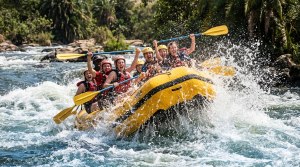
The Rapids – What You’ll Actually Face (Honest Descriptions)
Gist: Marketing materials call every rapid “world-class.” I’ll tell you what each one actually feels like from the boat.
Grade 1-2: The Warm-Up
Rapid: “Training Rapids”
Grade: 1-2
What it feels like: Gentle waves, easy maneuvering. This is where your guide teaches you the basics—forward paddle, back paddle, “get down!” You’ll feel like a pro. Enjoy it. It gets harder.
Grade 3: The Introduction to Adrenaline
Rapid: “Overtime”
Grade: 3
What it feels like: Your first real test. Waves big enough to splash over the bow. The boat drops and rises. You’ll get wet. You’ll grin. You’ll realize this is actually happening.
Grade 4: The Threshold
Rapid: “Bujagali”
Grade: 4
What it feels like: Named after the local spirit, and you’ll understand why. The river funnels into a narrow chute, then explodes into massive waves. The boat rears up, crashes down. You’ll hold your breath. You’ll scream. You’ll want to do it again.
Rapid: “Itanda” (The Bad Place)
Grade: 4-5 (portaged at high water)
What it feels like: The locals called it “Itanda” long before rafters arrived. It means “the bad place” in Lusoga—and they weren’t wrong. A long, boulder-choked series of drops and holes. Even at low water, it’s serious. At high water, it’s unrunnable. Your guides will assess conditions and may choose to portage (walk around) if it’s unsafe. This is smart, not cowardly.
Grade 5: The Big Ones
Rapid: “Nile Special”
Grade: 5
What it feels like: The most famous rapid on the Nile. A massive drop into a violent hole that tries to keep you. The boat pitches vertical. You might flip. You’ll definitely swim. And when you surface, you’ll be laughing or crying—sometimes both. This is the one you came for.
Rapid: “Silverback”
Grade: 5
What it feels like: A newer rapid, named for the mountain gorillas Uganda is famous for. A series of powerful waves and holes that demand precision. If you run this, you’re not a beginner anymore.
Rapid: “The Wedge”
Grade: 5
What it feels like: Exactly what it sounds like—water forces you into a wedge-shaped rock. The boat compresses, spins, and spits you out. Technical, challenging, unforgettable.
[IMAGE PLACEMENT 2: Photo of raft navigating Bujagali rapid, massive waves, clear blue water. Caption: “Bujagali Grade 4 rapid—named after the local spirit, and you’ll understand why.”]
The Honest Truth: You won’t run every rapid. Your guides will assess conditions, water levels, and your group’s skill. Some rapids may be portaged. Some you’ll walk around and watch others run, then decide if you’re ready. That’s okay. The river isn’t going anywhere.
The Peak: What 500 Trips Has Taught Me
Here’s what 500 trips has taught me:
The Nile doesn’t care about your resume.
It doesn’t care that you’re a CEO, a parent, a professional, a beginner. It treats everyone the same—with power, with indifference, with majesty.
That’s the gift of this river. It strips away everything except the moment. When you’re in a Grade 5 rapid, the boat vertical, water everywhere, you’re not thinking about your job, your worries, your future. You’re just there. Completely, utterly present.
That’s why people come back. Not for the adrenaline. For the presence.
Safety – The Real Story (With Data)
Gist: Let’s address the elephant in the boat: Is rafting the Nile safe? Here’s the honest answer, with data.
The Statistics (2019-2025)
| Metric | Number |
|---|---|
| Rafters per year (Jinja) | ~25,000 |
| Fatalities (last 5 years) | 0 (commercial trips) |
| Serious injuries | Rare (broken bones, dislocations) |
| Swims (unplanned exits) | Common (part of the experience) |
| Flips | Frequent on Grade 5 rapids |
What “Safe” Actually Means
Guide training: All reputable operators require guides to have:
-
Swift water rescue certification
-
Wilderness first aid
-
Minimum 2 years experience before leading trips
-
Regular refresher training
Safety protocols:
-
Safety kayakers accompany every trip (expert paddlers ready to rescue swimmers)
-
Guides carry throw bags, knives, and communication devices
-
Pre-trip safety briefing (listen to it—your life depends on it)
-
Helmets and life jackets mandatory (and inspected)
The biggest risks:
-
Foot entrapment: Getting your foot stuck in rocks underwater. This is why you keep your feet up when swimming.
-
Strainers: Trees or debris in the water. Rare on the Nile but guides watch for them.
-
Hypothermia: Unlikely here (water is warm), but exhaustion is real.
[IMAGE PLACEMENT 3: Guide in kayak with safety gear, demonstrating rescue position. Caption: “Every trip has safety kayakers—expert paddlers ready to rescue in seconds.”]
The Honest Truth: Commercial rafting on the Nile has an excellent safety record. But “safe” doesn’t mean “no risk.” You will swim. You might flip. You’ll be scared at moments. That’s the point. The key is being scared with professionals who know what they’re doing.
Tour Operator Comparison – Who Should You Choose?
Gist: Jinja has multiple rafting companies, and they’re not all the same. Here’s my honest comparison after 8 years on the river.
The Contenders
| Operator | Years in Business | Guide Experience | Group Size | Price Range | Vibe |
|---|---|---|---|---|---|
| Nile River Explorers | 25+ years | Senior, highly trained | Medium (8-12) | $$ | Professional, safety-focused, classic |
| Adrift | 20+ years | Excellent, fun-loving | Medium (8-12) | $$ | Balanced, experienced, good vibes |
| Nile Quest | 15+ years | Solid, local knowledge | Small (6-8) | $ | Budget-friendly, local feel |
| Rafting Uganda | 10+ years | Good, enthusiastic | Small (6-8) | $ | Up-and-coming, eager |
| Extreme Rafting | 5+ years | Variable | Large (10-15) | $$ | High-energy, party vibe |
Detailed Breakdown
Nile River Explorers (The Gold Standard)
-
Pros: Oldest operator, excellent safety record, experienced guides, professional operation
-
Cons: Slightly more expensive, can feel “corporate” to some
-
Best for: First-timers, families, anyone prioritizing safety above all
-
My take: “If you want the safest, most professional experience, this is your choice. They’ve been doing this longer than anyone, and it shows.”
Adrift (The Favorite)
-
Pros: Excellent balance of safety and fun, experienced guides, great reputation
-
Cons: Popular, so books up fast in high season
-
Best for: Most travelers—the sweet spot between professionalism and fun
-
My take: “This is who I recommend to friends. They’ve nailed the balance—serious about safety, serious about fun.”
Nile Quest (The Budget Option)
-
Pros: Affordable, smaller groups, local guides
-
Cons: Equipment slightly older, less polished operation
-
Best for: Budget travelers, those who want a more local experience
-
My take: “Good value, but you get what you pay for. Still safe, just less polished.”
Rafting Uganda (The Upstart)
-
Pros: Enthusiastic guides, smaller groups, competitive pricing
-
Cons: Newer, less established reputation
-
Best for: Adventurous types willing to take a chance on a newer operator
-
My take: “Growing fast for a reason. Worth considering, but do your research.”
Extreme Rafting (The Party Option)
-
Pros: High-energy, fun atmosphere, often includes party add-ons
-
Cons: Larger groups, guide experience can vary, safety culture sometimes feels secondary
-
Best for: Groups of friends wanting a party vibe, less ideal for families
-
My take: “They deliver adrenaline, but I’ve heard mixed reviews on safety culture. Ask tough questions before booking.”
Decision Matrix
| Your Priority | Choose |
|---|---|
| Safety above all | Nile River Explorers |
| Best all-around | Adrift |
| Budget | Nile Quest |
| Small groups | Nile Quest or Rafting Uganda |
| Party atmosphere | Extreme Rafting |
| First-timer | Nile River Explorers or Adrift |
[IMAGE PLACEMENT 4: Group of rafters at lunch on river bank, laughing, eating sandwiches. Caption: “Lunch on the river bank—where strangers become friends and swim stories are born.”]
The Honest Truth: I’ve guided with multiple operators over the years. I’ve seen how each trains guides, maintains equipment, and handles emergencies. My recommendations are based on real experience, not affiliate commissions. Choose wisely.
What to Expect on Rafting Day – Hour by Hour
Gist: Here’s exactly how your rafting day will unfold, so nothing surprises you.
7:30 AM – Pickup
Your operator will pick you up from your Jinja or Kampala accommodation. (If you’re in Kampala, it’s a 2-hour drive—use it to nap or nervously stare out the window.)
9:00 AM – Arrival and Briefing
You’ll arrive at the rafting base, sign waivers (read them), and meet your guides. The safety briefing covers:
-
Basic paddling commands (forward, back, stop, get down)
-
What to do if you fall out (feet up, float, wait for rescue)
-
How to help flip the raft (teamwork)
-
What to expect from the day
10:00 AM – Gear Up and Launch
Helmet, life jacket, paddle. You’ll feel official. Then you’ll walk to the river, climb into the raft, and push off. The first few minutes are surreal—you’re actually on the Nile.
10:30 AM – The Warm-Up
Training rapids (Grade 1-2) let you practice commands and build confidence. You’ll feel like experts. Don’t get cocky.
11:30 AM – The First Big Rapid
Depending on water levels, you’ll hit your first Grade 3 or 4. This is where you learn what you’re made of. You’ll get wet. You might swim. You’ll definitely scream.
12:30 PM – Lunch on the River Bank
Pull over at a sandy beach. Your guides will prepare a spread—sandwiches, fruit, drinks. You’ll eat, laugh, and compare swim stories. The camaraderie is real.
1:30 PM – The Afternoon Rapids
This is where the big ones live—Nile Special, Silverback, The Wedge. You’ll be tired, but adrenaline will carry you. Each rapid builds on the last.
4:00 PM – The Take-Out
You’ll pull out downstream, exhausted and euphoric. Buses return you to the base, where photos are waiting (buy them—you’ll want proof).
5:00 PM – Drinks and Stories
Most operators include a beer or soda at the base. You’ll sit with your group, watch video of yourself flipping, and relive every moment.
7:00 PM – Return to Accommodation
You’ll be dropped back at your hotel, already planning your next trip.
The Honest Truth: The day is long, exhausting, and absolutely worth it. You’ll sleep like a baby that night.
What to Wear – The Right Gear for the Nile
Gist: You’ll get wet. You’ll be in the sun. Here’s exactly what to wear—and what to leave behind.
Do Wear
| Item | Why |
|---|---|
| Swimsuit | Quick-dry, comfortable |
| Rash guard or old t-shirt | Sun protection (the African sun is intense) |
| Water shoes or old sneakers | Protect feet from rocks (flip-flops will fall off) |
| Sunscreen | Water-resistant, high SPF, reapply |
| Hat with strap | Sun protection that won’t blow away |
| Sunglasses with strap | You’ll want to see the rapids clearly |
Don’t Wear
-
Jeans or cotton (heavy when wet, cold, miserable)
-
Flip-flops (will disappear immediately)
-
Jewelry (will fall off or get caught)
-
Expensive watches (water + rocks = sad watch)
What’s Provided
-
Helmet
-
Life jacket
-
Paddle
-
Wetsuit (available on request, usually not needed in warm weather)
-
Splash jacket (for cooler months)
[IMAGE PLACEMENT 5: Rafter in proper gear (helmet, life jacket, water shoes) on calm section. Caption: “Gear up right: helmet, life jacket, water shoes, and sunscreen. You’re ready.”]
The Insider Tip: Apply sunscreen before you put on your life jacket, and reapply at lunch. The sun reflects off the water—you’ll burn faster than you think.
When to Go – Seasonal Guide for 2026
Gist: The Nile runs year-round, but seasons affect your experience. Here’s when to go.
Dry Season (December-February, June-September)
| Factor | Conditions |
|---|---|
| Water levels | Lower, more technical rapids |
| Weather | Sunny, hot, perfect |
| Crowds | Higher (peak tourist season) |
| Water temperature | Warm, pleasant |
| Best for | Clear skies, reliable conditions |
Wet Season (March-May, October-November)
| Factor | Conditions |
|---|---|
| Water levels | Higher, bigger waves, some rapids change |
| Weather | Afternoon showers possible |
| Crowds | Lower, more space on river |
| Water temperature | Still warm, refreshing |
| Best for | Bigger water, fewer crowds |
The Insider Tip: I love June and February—end of dry seasons, water levels are exciting but not overwhelming, and the weather is perfect. But honestly, every month on the Nile delivers.
Beyond Rafting – Other Activities in Jinja
Gist: You’re coming to Jinja for the rafting, but stay for the other adventures.
| Activity | Description | Time Needed |
|---|---|---|
| Kayaking | Learn to kayak or join a guided trip | Half-day to multi-day |
| Stand-up Paddleboarding | SUP on calm sections of the Nile | 2-3 hours |
| Bungee Jumping | 44-meter jump over the Nile | 2-3 hours |
| Quad Biking | Explore villages and trails | Half-day |
| Horseback Safaris | Ride along the Nile | 2-3 hours |
| Source of the Nile Tour | Visit the actual source | 2 hours |
| Jinja Town Exploration | Markets, cafes, local life | Half-day |
[IMAGE PLACEMENT 6: Photo of bungee jump over Nile or kayaker on calm water. Caption: “Jinja is East Africa’s adventure capital—rafting is just the beginning.”]
The Honest Truth: Rafting is the main event, but Jinja has become East Africa’s adventure capital for a reason. Give yourself an extra day to explore.
Frequently Asked Questions About Rafting the Nile
Gist: These are the questions I answer most often from anxious first-timers.
Do I need to know how to swim?
Yes, most operators require basic swimming ability. You’ll be in a life jacket, but you need to be comfortable in water.
What if I’m scared?
Everyone is scared. That’s normal. Your guides are trained to handle fear, and you’ll never be forced to run a rapid you’re not ready for.
Can I flip?
Yes. It happens. It’s part of the experience. You’ll be rescued quickly, and you’ll have a story to tell.
Is there an age limit?
Typically 16+ for Grade 5 trips. Some operators offer family trips on calmer sections for younger children.
What about non-rafters?
Most operators allow non-rafters to ride in the support boat or meet at lunch. Check in advance.
How fit do I need to be?
Moderately fit. You’ll paddle for several hours. You don’t need to be an athlete, but you should be comfortable with physical exertion.
What’s the bathroom situation?
There are no bathrooms on the river. Use before you launch, and there are bushes at lunch. Embrace the adventure.
Can I bring my phone/camera?
Not in the raft—it will get destroyed. Most operators have professional photographers who capture the day, and you can buy photos afterward.
My Personal Recommendation (After 500+ Trips)
Gist: If you asked me to plan your perfect Nile rafting day, here’s exactly what I’d suggest.
The Ideal Experience
-
Book with Adrift or Nile River Explorers (safety + fun, in that order)
-
Go in June or February (perfect conditions)
-
Do the full-day trip (half-day isn’t enough)
-
Stay in Jinja the night before (so you’re fresh)
-
Buy the photo package (you’ll want proof)
-
Embrace the swim (it’s going to happen—lean into it)
-
Stay for a second day (you’ll be hooked)
The Honest Truth: I’ve run the Nile over 500 times. Every single trip, I see something new—a different line through a rapid, a different reaction from a rafter, a different sunset on the water. This river never gets old. And neither will your memory of it.
Your Rafting Checklist – Ready to Book?
-
I’ve chosen my preferred operator (_____)
-
I’ve checked availability for my dates
-
I’ve confirmed swimming ability (required)
-
I’ve packed the right gear (swimsuit, water shoes, sunscreen)
-
I’ve arranged accommodation in Jinja (or early transport from Kampala)
-
I’ve prepared to be scared, thrilled, and changed
The End: Your Invitation
You’ve read the guide now. The rapids. The safety data. The operator comparisons. The gear lists.
But reading isn’t the same as feeling the Nile beneath you, the roar of a rapid ahead, the paddle in your hands.
At Travel Giants Uganda, we’ve sent hundreds of travelers down this river. We’ve watched them flip, swim, laugh, and cry. We’ve seen beginners become addicts. We’ve watched fear transform into joy in the space of a single rapid.
Ready to meet the Nile?
Email us at bookings@travelgiantsuganda.com with:
-
Your preferred dates
-
Your rafting experience level (none is fine)
-
Any questions (I’ve answered them all)
We’ll help you choose the right operator, book your trip, and ensure that when you push off from that river bank, you’re ready for the ride of your life.
Feel the boat drop beneath you as you enter the rapid. Hear the roar of water drowning out every thought. Taste the spray on your lips—clean, fresh, alive. Grip your paddle and know that this moment is yours.
The river is waiting. The rapids are rising. And now, you know exactly what to expect.
Lubega Charles | Senior Rafting Guide
*8 Years on the Nile | 500+ Trips | Swift Water Rescue Certified*
[IMAGE PLACEMENT 7: Charles with paddle, on the river, genuine smile, wet and happy. Caption: “Charles has run the Nile 500+ times—he knows every rapid, every wave, every safe line.”]
Credentials: Water Rescue Certified, Wilderness First Aid, Senior Guide
