
There is a sound you will never hear from a safari vehicle. It is the crunch of dry grass under your own boots, punctuated by the distant alarm call of a francolin and the low rumble of something large, somewhere ahead, moving through the acacia. Your ranger stops. Everyone stops. The wind shifts. And for a few seconds, the bush tells you exactly where the animals are — information you would never have received from behind a windscreen.
This is a walking safari. And in Uganda, it is one of the least-known, least-booked, and most rewarding ways to experience the wilderness.
Uganda is not Kenya or Zambia or Zimbabwe, where multi-day walking safaris in big game country are a well-established industry. Ugandan park regulations are conservative, and walking is only permitted in specific areas, under specific conditions, with an armed ranger who has the authority to turn you around if conditions change. That conservatism has a purpose: you are on foot in country that contains elephants, buffalo, and — in some areas — lions.
But where walking is permitted, it transforms the experience. You notice things you would drive past. You learn to read the bush rather than simply observe it. And you spend a few hours, at least, moving through Africa at the pace Africa moves.
This is the complete guide to walking safaris in Uganda — where they are permitted, what they cost, what you will actually see, and how to build one into your itinerary.
Why Walking Changes Everything
Your Senses Come Online
A game drive is a visual experience. You sit, you scan, you photograph. A walking safari engages all of your senses at once.
You hear the alarm call of a baboon or an impala, which every guide reads as a signal of a predator nearby. You smell elephant, musky and unmistakable, before you see it. You feel the heat radiating off a rock, and the sudden cool of moving into shade. You notice the tracks — a leopard’s print in soft earth, a buffalo’s hoof marks crossing a trail, the drag marks of something large that passed through yesterday.
Many experienced safari-goers say the same thing: they learned more about African wildlife in a two-hour walk than in a week of game drives.
You See the Small Things
From a vehicle, the focus is on the headline animals. On foot, the small details become visible:
-
Tracks and signs — prints, scat, feeding evidence, scratch marks on trees
-
Birdlife — you have time to actually identify what you are hearing and seeing
-
Insects and reptiles — the drama of the smaller bush, which is constant and extraordinary
-
Plants — medicinal species, edible tubers, the plants elephants avoid and the ones they devour
-
Geology and ecology — how the landscape was formed, why certain trees grow where they do
Your ranger will explain these as you walk. The bush becomes legible.
You Are at Ground Level
This sounds obvious, but it matters. In a vehicle, you are a spectator — elevated, insulated, separate. On foot, you are inside the landscape. You move the way animals move. You are aware of wind direction and cover and distance in a way that simply does not register from a vehicle seat.
It is also, frankly, more exciting. There is a genuine — if carefully managed — edge to walking in country where elephants and buffalo live.
It Is Intimate
Walking groups are small — typically four to eight people, sometimes fewer. There is no engine noise, no convoy, no radio chatter between guides. You and your ranger and a handful of fellow travellers, moving quietly through the bush.
For solo travellers, this is often the most social activity on a safari. For couples, it is a genuinely shared experience rather than two people sitting in the same vehicle.
Where Walking Is Permitted in Uganda
Walking is not permitted freely across Uganda’s parks. The rules vary significantly by location, and some parks allow it only in specific zones or with specific conditions attached.
Here is where it works.
Lake Mburo National Park: Uganda’s Walking Safari Capital
The best and most established option. Lake Mburo is Uganda’s smallest savannah park and the only savannah park where walking is permitted across substantial areas. The reason is straightforward: the park has no resident lions and no elephants, which dramatically reduces the risk profile and allows visitors to leave the vehicle.
The signature walk departs from Rwonyo Park Headquarters and lasts approximately two hours, led by an armed Uganda Wildlife Authority ranger. The route passes through open savannah and acacia woodland, and typically includes a stop at a salt lick — a natural mineral deposit that attracts zebras, impalas, buffalo, warthogs, and occasionally eland.
Because Lake Mburo is also the only park in Uganda with a significant zebra population, walking here often means walking among zebras — close enough to watch their ears swivel and to hear the soft snort of alarm when they catch your scent. Impalas will leap away as you approach. Buffalo are usually visible at a respectful distance, and your ranger will be very clear about how close you can get.
Cost: Approximately USD $30 per person** for the guided walk, in addition to standard park entry of **$40 per day for foreign non-residents.
Duration: 2 hours (shorter and longer options exist).
Best for: First-time walkers, families, photographers, anyone wanting a genuine wildlife encounter on foot without technical difficulty.
Ziwa Rhino Sanctuary: Tracking Rhinos on Foot
The most unusual walking experience in Uganda. At Ziwa Rhino Sanctuary, on the Kampala–Murchison highway, you track rhinos on foot — one of the very few places in Africa where this is possible.
Led by experienced rangers and trackers, you walk through bush and grassland until you find a rhino — sometimes a mother with a calf, sometimes a group grazing. You approach on foot, maintaining a respectful distance, and spend time observing these enormous animals at close range. The tracking itself takes 1 to 3 hours depending on how far the rhinos have moved.
The experience is a highlight of the drive north to Murchison Falls, and the only way to complete the Big Five in Uganda without leaving the route.
Cost: Approximately USD $40–$50 per person.
Best for: Anyone en route to Murchison Falls, travellers completing the Big Five, photographers.
Murchison Falls National Park: Walks at the Falls and Beyond
Murchison Falls permits walking in specific, managed contexts rather than general bush walking. The most well-known is the top of the falls walk — a steep 45-minute climb from the base of the falls to the top, ending beside the point where the entire Victoria Nile forces itself through a seven-metre gap in the rock.
The walk is included in the standard park entry fee, and the reward — standing beside the thundering Nile at the point where Churchill once marvelled at its untamed power — is one of the great experiences of a Ugandan safari.
Guided nature walks with an armed ranger are also available in some areas of the park, and the Budongo Forest and Kaniyo Pabidi areas offer forest walks that combine chimpanzee tracking with birdwatching.
Cost: The top of the falls walk is included in park entry. Guided bush walks are typically $20–$30 per person.
Best for: Anyone visiting Murchison Falls — the falls walk in particular is not optional, it is essential.
Queen Elizabeth National Park: Maramagambo and Kyambura
Queen Elizabeth does not offer open savannah walking, but it does offer two excellent forest-based walking experiences.
Maramagambo Forest offers guided nature walks ranging from 2 to 6 hours, passing through the largest continuous forest block within the park. The trails lead to a volcanic tube cave home to tens of thousands of Egyptian fruit bats, viewed from a purpose-built platform. Other trails follow the River Kajojo, pass exotic palm groves, and end at the Kilyantama Waterfalls.
Kyambura Gorge — the “Valley of Apes” — involves a steep descent into a sunken forest to track chimpanzees, which offers a genuinely different kind of walking: demanding, enclosed, and unforgettable.
Cost: Maramagambo nature walks approximately $30 per person. Kyambura chimpanzee trekking approximately $100 per person.
Best for: Forest lovers, birdwatchers, travellers seeking shade and cool air.
Kibale Forest: The Bigodi Swamp Walk
Kibale’s most celebrated walking experience is not in the national park itself but in the Bigodi Wetland Sanctuary just outside its boundary — a community-run conservation project offering one of Uganda’s finest forest walks.
The swamp is home to eight primate species, including black-and-white colobus, red colobus, grey-cheeked mangabeys, and L’Hoest’s monkeys. Over 200 bird species have been recorded, including the great blue turaco and the papyrus gonolek.
The walk typically lasts 2 to 3 hours and is run by the Kibale Association for Rural and Environmental Development (KAFRED), which channels proceeds directly into local community development.
Cost: Approximately $30 per person.
Best for: Primate lovers, birders, travellers who want their tourism spending to reach local communities directly.
Bwindi and Mgahinga: Forest and Cultural Walks
Gorilla trekking itself is a walk — often a demanding one — but both parks offer additional walking experiences.
The Batwa Cultural Trail in Mgahinga is the most significant. Led by Batwa guides, it takes visitors through the forest over 4 to 5 hours, sharing traditional knowledge, survival skills, medicinal plants, and the stories of the forest’s first people. It is one of the most moving walking experiences in Uganda.
Bwindi’s community walks — including the Buhoma Village Walk and the waterfall trail — offer gentler options, passing through villages, tea plantations, and forest edge.
Cost: Batwa Trail approximately $80 per person. Bwindi community walks approximately $20–$30 per person.
Best for: Travellers who want cultural context alongside the wildlife, and anyone spending extra days around gorilla trekking.
Rwenzori, Elgon, and the Volcanoes: Walking as Trekking
Uganda’s mountains are, by definition, walking destinations — but they are treks rather than safaris.
The Rwenzori Mountains offer 7-to-10-day expeditions through five vegetation zones to glacial peaks at 5,109 metres. Mount Elgon offers 3-to-5-day treks to a vast volcanic caldera. Mgahinga’s volcanoes offer single-day summit hikes on Muhabura (4,127m), Sabyinyo (3,645m), and Gahinga (3,474m).
These are covered in detail elsewhere, but they represent the most physically demanding walking Uganda offers.
Kidepo Valley: Walks in the Last Wilderness
Kidepo permits guided nature walks with an armed ranger in the Narus Valley, and the Mount Morungole hike — approximately 12 kilometres round trip to 2,750 metres — is one of Uganda’s finest day walks, with views across the park and the opportunity to visit Ik communities on the slopes.
Cost: Nature walks approximately $20–$30 per person. Mount Morungole hike approximately $30–$50 per person.
Best for: Travellers already committed to the long journey to Kidepo.
The Rules: Why They Exist and What They Mean for You
Walking safaris in Uganda are governed by strict rules. They are not bureaucratic obstacles — they are the reason walking is permitted at all.
An armed ranger is mandatory. Every walking safari in Uganda is led by a Uganda Wildlife Authority ranger carrying a firearm. The ranger’s job is not to shoot animals. It is to read the bush, make decisions about approach and retreat, and — in the extremely unlikely event of a genuine threat — to manage it. Follow their instructions without question.
Group sizes are limited. Typically four to eight people. Smaller groups are quieter, less conspicuous, and safer.
You walk in single file, behind the ranger. No wandering off. No lagging behind. No photographing at the back of the line.
You keep your voice low. Animals react to human voices. Whispering preserves the experience for everyone, including you.
You do not approach wildlife on your own initiative. If your ranger stops, you stop. If your ranger signals you to move back, you move back immediately. There is no negotiation.
You dress appropriately. Muted colours — khaki, olive, grey, brown. No bright whites, no neon. Comfortable closed shoes, long trousers, and long sleeves for vegetation and insects.
Do not run. Running triggers predatory responses in animals, including herbivores. If a retreat is necessary, it will be conducted calmly and deliberately under your ranger’s direction.
Know what to do in an encounter. Your ranger will brief you. Generally: stand still, stay together, keep low voices, follow instructions. Do not turn your back and flee.
What You Will Actually See on Foot
This is the honest section, because expectations matter.
What walking gives you: Tracks, signs, scat, feeding evidence, birds, insects, plants, smaller mammals, and — most importantly — an understanding of how the ecosystem fits together. You will see zebras and impalas and buffalo and warthogs at close range in Lake Mburo. You will see rhinos on foot at Ziwa. You will see primates, birds, and forest detail in Kibale and Maramagambo.
What walking does not give you: You will not see lions or leopards on a walking safari in Uganda. You will not see elephants up close in most walking areas, because elephants are precisely why walking is restricted in the parks where they live. You will not see the big game spectacles that a game drive delivers.
A walking safari is not a substitute for a game drive. It is a complement. Do both. The walking will make you better at the driving — you will notice things from the vehicle that you would otherwise have missed.
Costs at a Glance
| Location | Activity | Cost (USD) | Duration |
|---|---|---|---|
| Lake Mburo | Guided walking safari | $30 | 2 hours |
| Ziwa Sanctuary | Rhino tracking on foot | $40–$50 | 1–3 hours |
| Murchison Falls | Top of the falls walk | Included in park entry | 45 min |
| Murchison Falls | Guided bush walk | $20–$30 | 1–2 hours |
| Maramagambo Forest | Nature walk | $30 | 2–6 hours |
| Kyambura Gorge | Chimpanzee trek | $100 | 2–4 hours |
| Bigodi Swamp | Community wetland walk | $30 | 2–3 hours |
| Mgahinga | Batwa Cultural Trail | $80 | 4–5 hours |
| Bwindi | Community village walk | $20–$30 | 2–3 hours |
| Kidepo | Nature walk | $20–$30 | 1–3 hours |
| Kidepo | Mount Morungole hike | $30–$50 | 6–8 hours |
All costs are in addition to standard park entry fees ($40–$45 per day for foreign non-residents, depending on the park).
What to Wear and Pack
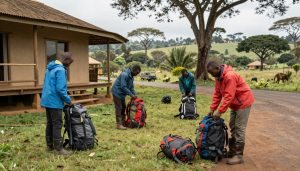
Clothing:
-
Long trousers — protection from vegetation, insects, and sun
-
Long-sleeved shirt — same reasons
-
Neutral colours — khaki, olive, grey, brown. Avoid white and bright colours
-
Comfortable, closed walking shoes or light hiking boots — not sandals, not flip-flops
-
A hat and sunglasses
-
A light rain jacket — weather changes fast
Gear:
-
Binoculars — essential for birds and distant wildlife
-
Camera — with a strap you can secure. You will need both hands free at times
-
Water — at least 1.5 to 2 litres per person
-
Insect repellent with DEET or picaridin
-
Sunscreen
-
A small daypack to carry it all
What not to bring:
-
Drone (requires a permit and is prohibited in national parks without written permission)
-
Bright or camouflage clothing
-
Loose jewellery
-
Anything that rustles loudly
The Best Time to Walk
The dry seasons — June to September and December to February — are the best time for walking safaris. Trails are firm, vegetation is shorter and easier to see through, and the weather is more predictable.
Walking in the wet seasons (March–May and October–November) is possible in most locations, but trails become muddy, insects are more numerous, and vegetation is denser and wetter. The advantage is fewer other walkers and lush green scenery.
Time of day: Early morning is the best time for walking. Temperatures are cooler, wildlife is active, and birds are at their most vocal. Most Lake Mburo walks depart around 7:00 AM. Late afternoon walks are the second-best option, with golden light and animals moving toward water.
Sample Walking Itinerary
Day 1: Arrive Entebbe. Transfer to Lake Mburo National Park.
Day 2: Morning guided walking safari from Rwonyo — zebras, impalas, buffalo, and the salt lick. Afternoon boat cruise on Lake Mburo. Evening night game drive.
Day 3: Transfer to Queen Elizabeth National Park. Afternoon Kazinga Channel boat cruise.
Day 4: Morning game drive on the Kasenyi Plains. Afternoon nature walk in Maramagambo Forest — bats, birds, and the Kilyantama Waterfalls.
Day 5: Transfer to Kibale Forest. Afternoon Bigodi Wetland Sanctuary walk with KAFRED.
Day 6: Chimpanzee tracking in Kibale.
Day 7: Transfer to Bwindi. Afternoon community village walk or Batwa Cultural Trail.
Day 8: Gorilla trekking.
Day 9: Optional second walk or Lake Bunyonyi community walk. Departure.
This itinerary combines walking with game drives, boat cruises, and primate trekking — the full Ugandan safari experience with a genuinely different sensory dimension.
The Verdict: Slow Down and Walk
Uganda’s safari industry is built on vehicles. Game drives are the default, and for good reason — they cover distance, they are comfortable, and they deliver the big sightings. Walking safaris are the exception, not the rule.
But exceptions are often where the most memorable experiences live.
Walking in Lake Mburo, with zebras grazing twenty metres away and a ranger reading the wind. Tracking rhinos on foot at Ziwa. Walking the Batwa Trail through the forest with guides whose ancestors lived there. Climbing to the top of Murchison Falls and standing where the entire Nile disappears into the rock.
These are not the experiences that make the brochures. They are the experiences travellers talk about years later.
The bush is not the same from a vehicle. Walk it, and you will understand why.
Ready to see Uganda on foot? Contact TravelGiantUganda.com to add walking safaris to your itinerary — with guided walks in Lake Mburo, rhino tracking at Ziwa, forest walks in Maramagambo and Bigodi, and ranger-led experiences arranged across the country.
