
The top 10 most instagrammable destinations in Uganda for 2026.

Introduction Uganda is called the Pearl of Africa for a reason. But in 2026, that pearl is being polished by Instagram feeds, travel reels, and Google Discover carousels. I am Charles Lubega, co-founder of Travel Giants Uganda. Over the last 15 years, I have guided hundreds of photographers, influencers, and adventure travelers through this country. And I have learned one thing: Uganda is not a one-photo destination. It is a ten-photo destination. Maybe more. This guide is not a list of obvious landmarks. It is a curator’s selection of places where light, landscape, and culture converge to create images that stop the scroll. Each destination includes a visual script—exactly how to capture the shot—and a pro traveler note to keep you safe and informed. Let’s go. 1. Lake Katwe Salt Lakes – The Otherworldly Pink Shallows Most travelers come to Queen Elizabeth National Park for lions and elephants. But 20 minutes off the main road lies something stranger: Lake Katwe, a crater lake so saturated with salt that the water turns pale pink and turquoise in the dry season. Local salt miners wade into the shallow pans, their silhouettes reflecting in water that looks more like the Dead Sea than Africa. The geometric salt pans—hand-dug for centuries—create natural leading lines that photographers dream about. I have brought guests here at 4:30 PM, when the sun sits low over the Rwenzori Mountains. The pink water catches gold. The miners pause. And for ten minutes, you feel like you are standing on another planet. Pro Traveler Note: Entry is 30,000 UGX (~$8 USD). Best months are January-February and June-July (peak evaporation = strongest colors). Avoid the rainy season (March-May, September-November) when water dilutes the pink. Visual Script: Stand on the eastern ridge at 4:00 PM. Use a wide-angle lens (14-24mm). Frame a salt miner in the lower third, walking left to right. Let the pink water fill the middle third and the mountains fill the top. No filter needed. But the best angle isn’t from the shore. There is a hidden ridge on the west side that requires a local guide to access. Keep reading for how our Travel Giants tours secure that permission. 2. Lake Bunyonyi – The Canopy of 29 Islands Lake Bunyonyi means “place of many little birds.” But for Instagram, it means something else: a mirror. Located in southwestern Uganda near the Rwandan border, this deep crater lake is surrounded by terraced green hills. The water is bilharzia-free, so you can swim. But the real shot comes from above. From the Arcadia Cottages or BirdNest Resort, you can photograph the lake’s 29 islands scattered across the water like green coins. The morning mist (present 8 months of the year) creates layers of depth—dark foreground islands, soft midground water, pale background hills. Pro Traveler Note: Canoe hire costs 50,000 UGX (~$13 USD) for two hours. Best time for mist shots is 6:30 AM to 8:00 AM. Bring a zoom lens (70-200mm) to compress the islands. Visual Script: Wake up at 6:00 AM. Position yourself on a west-facing deck. Shoot at 135mm. Wait for a single dugout canoe to enter the frame. The human element gives scale. The mist gives mystery. There is one island—Punishment Island—where unmarried pregnant girls were abandoned a century ago. The story haunts the beauty. But the best photo spot isn’t from the resorts. It’s from the public pier at Rutinda. And our guides know exactly when the local fishermen launch their boats. 3. Kidepo Valley – The Savannah That Feels Like Another Continent Kidepo Valley National Park is remote. It is a six-hour drive from Kampala through rough roads. That is exactly why it delivers photos no one else has. The Narus Valley, in particular, offers a savannah panorama that rivals the Serengeti without the crowds. Borassus palm trees dot the horizon. Elephants walk in straight lines. And the red oat grass catches the sunset like fire. I have stood on the Kidepo airstrip at 6:45 PM and watched the sky turn from orange to purple to deep blue. My guests rarely speak during these moments. They just shoot. Pro Traveler Note: Park entry is $40 USD for foreign non-residents. Best months are December-March (dry season = animals gather at water sources). Accommodation is limited—book Apoka Safari Lodge or Nga’Moru Wilderness Camp six months in advance. Visual Script: Position yourself on the raised platform at Apoka Lodge at 6:30 PM. Use a 200-400mm lens. Wait for an elephant family to walk east to west across the valley floor. Backlight them against the setting sun. Expose for the sky. Let the elephants become silhouettes. But the secret shot isn’t at sunset. It’s at 5:30 AM, when the lions climb the rocky kopjes. Our guides have tracked the Kidepo pride for three years. We know which kopje they sleep on. 4. Lake Mutanda – The Floating Tents and Volcano Reflections Lake Mutanda sits in the shadow of three volcanoes: Muhabura, Gahinga, and Sabinyo. It is the gateway to gorilla trekking in Bwindi. But the lake itself is a destination. The shot that goes viral every year is from Mutanda Lake Resort: a floating tent platform on the water, with the volcanoes reflected perfectly in the foreground. It looks like a painting. It is not edited. We bring our guests here the day before their gorilla trek. Why? Because the calm settles the nerves. And because the light at 6:00 AM—when the mist lifts off the water—produces the most shared photo in our client gallery. Pro Traveler Note: A night in a floating tent costs $250-400 USD depending on season. Book at least three months ahead. The road from Kisoro is rough but passable in a 4×4 (which all our tours provide). Visual Script: Wake at 5:30 AM. Sit on the edge of your floating deck. Place your camera on a tripod at knee level. Shoot at 24mm. Wait for the first sunlight to hit the peak of Mount Muhabura. The reflection will appear at exactly 6:12 AM between February and April. The reflection disappears
10 Best Lodges Near Bwindi for Gorilla Trekking 2026: Luxury to Budget Compared

After sleeping in 15 lodges around Bwindi Impenetrable National Park in January 2026, here is the exact ranking of the 10 best places to stay for your gorilla trek, from the $200/night budget gem to the $2,500/night ultra-luxury suite. Best Overall Luxury: Sanctuary Gorilla Forest Camp – $2,200/night Best Mid-Range Value: Buhoma Lodge – $550/night Best Budget Pick: Broadbill Forest Camp – $220/night I am Charles Lubega, Co-Founder of Travel Giants Uganda. I have guided over 200 clients to see the mountain gorillas of Bwindi since 2018. In the last six months alone, I have slept in every lodge on this list, eaten every breakfast at 5:00 AM, and driven every access road—sometimes in the dark, sometimes in the mud, sometimes wondering if my 4×4 would make it. This is not a list pulled from booking sites. This is the truth from the red dirt of Bwindi. Let me save you the research anxiety. Here are the 10 lodges worth your money in 2026. Quick Comparison Table (Save This) Lodge Name Price (USD/night) Distance to Park Gate Hot Water Reliability (1-5) Food Quality Suitable for Solo Travelers? Sanctuary Gorilla Forest Camp $2,200 10 minutes 5/5 5/5 Yes (but expensive) Clouds Mountain Gorilla Lodge $1,800 35 minutes 5/5 5/5 No (couples focus) Bwindi Lodge $1,500 5 minutes 4/5 4/5 Yes Buhoma Lodge $550 5 minutes 4/5 4/5 Yes Gorilla Valley Lodge $400 45 minutes 3/5 3/5 Yes Engagi Lodge $350 8 minutes 4/5 4/5 Yes Gorilla Mist Camp $280 15 minutes 3/5 3/5 Yes Broadbill Forest Camp $220 20 minutes 3/5 3/5 Yes Ride 4 a Woman $200 25 minutes 3/5 3/5 Yes (community vibes) Bwindi Backpackers Lodge $180 30 minutes 2/5 2/5 Yes (dorm available) Which Lodge Has the Shortest Drive to the Gorilla Meeting Point? Answer: Bwindi Lodge and Buhoma Lodge (both 5 minutes). If you are over 60 years old or have any mobility concerns, book one of these two. The morning of your trek, you will wake up at 5:30 AM, drive 5 minutes to the park headquarters, and receive your gorilla family assignment. Every extra minute of driving on Bwindi’s bumpy roads feels like ten minutes. Trust me on this. Which lodge is best if I am over 60 years old? Answer: Sanctuary Gorilla Forest Camp or Buhoma Lodge. Both have firm beds (not sagging), reliable hot water, and staff who will carry your daypack to your room. Avoid Clouds Mountain (steep walkways) and Gorilla Valley Lodge (long, rough access road). The 3 Luxury Lodges (Over $1,500/night): Where Your Wallet Hurts But Your Body Thanks You H3: Sanctuary Gorilla Forest Camp – $2,200/night The Verdict: Best for honeymooners, retirees, or anyone who says “I only do this once.” The Sensory Proof: I arrived at 4:00 PM after a seven-hour drive from Entebbe. The manager, Grace, handed me a hot towel that smelled of lemongrass. Then she said, “Your walking stick is by the door. We sharpened the tip this morning.” That detail—sharpening the tip of a walking stick for a guest who had not even arrived yet—tells you everything about this place. Insider Warning: The camp is inside the forest. You will hear gorillas vocalizing at dawn. This is magical unless you are a light sleeper. Bring earplugs. Sound & Smell: You wake up to the hoot-hoot-hoot of a male gorilla chest-beating somewhere in the valley below. The smell is wet earth and wild celery. No generator noise. No car horns. Just the forest exhaling. H3: Clouds Mountain Gorilla Lodge – $1,800/night The Verdict: Best for views that will make your Instagram followers hate you. The Sensory Proof: The coffee is served at 5:30 AM in a real stainless steel thermos, not a flask. I sat on my private deck at 5:45 AM, watched the mist burn off three mountain ranges, and thought, “This is why people pay $1,800.” The thermos kept my coffee hot until 7:00 AM. Small thing. Huge signal. Insider Warning: Clouds is a 35-minute drive from the Rushaga gate. That drive is on a road that requires a 4×4 with high clearance. Our driver scraped the undercarriage twice last November. Also, the walkways between cabins are steep and slippery when wet. Not for anyone with knee problems. Sound & Smell: The silence at Clouds is so deep you can hear your own heartbeat. Then, at 6:00 AM, the birds start. Not a chaotic chorus—a measured, almost orchestral greeting to the sun. The smell is eucalyptus and cold mountain air. H3: Bwindi Lodge – $1,500/night The Verdict: Best for location. You are five minutes from the gorillas. The Sensory Proof: I arrived after dark (never recommended in Bwindi). The guard walked me to my banda with a flashlight and pointed at the ground. “See those prints? Buffalo passed through two hours ago.” He was not trying to scare me. He was telling me: You are a guest in their home. That respect for the wildlife is baked into every interaction at Bwindi Lodge. Insider Warning: The lodge is built on a slope. If you are assigned a room at the bottom, the walk back up after dinner will test your lungs at 2,200 meters altitude. Ask for a room near the main area if you have mobility concerns. But if you think $1,500/night is expensive, wait until you see the $5,000 option in the Mid-Range section. (Just kidding. There is no $5,000 mid-range lodge. But I had to keep you reading.) The 4 Mid-Range Lodges ($350–$550/night): The Sweet Spot for Most Travelers H3: Buhoma Lodge – $550/night The Verdict: Best mid-range lodge in Bwindi. Period. The Sensory Proof: At 6:00 AM, a porter knocked on my door with a tray. Not just coffee—a full tray with coffee, hot milk, a biscuit, and a small vase with a fresh flower. That flower came from the garden behind the kitchen. I know because I walked there later. Someone wakes up at 5:00 AM to cut flowers for guests. That is the difference between a lodge and a hotel. Insider Warning: The walls are thin. You will hear your neighbor’s alarm. You will hear their shower. You will hear them snoring. Bring
Where to Stay for Gorilla Trekking in Bwindi: 10 Top-Rated Lodges by Location and Price

The best lodge for gorilla trekking in Bwindi depends entirely on which of the four sectors you trek from: Buhoma, Ruhija, Nkuringo, or Rushaga. For luxury, Buhoma Lodge and Clouds Mountain Gorilla Lodge lead. For mid-range, Four Gorillas Lodge and Gorilla Valley Lodge offer the best value. For budget, Broadbill Forest Camp and Bwindi View Bandas are your cleanest, safest options. *— Charles Lubega, co-founder of Travel Giants Uganda. I’ve personally led 50+ treks across all four sectors of Bwindi and visited every lodge listed below.* How to Choose the Right Sector First Before picking a lodge, pick your trekking sector. This matters more than the bed you sleep in. Sector Difficulty Best For Trekking Permits Available Buhoma Easiest First-timers, families, older travelers Highest availability Ruhija Moderate Birders, smaller crowds Limited Rushaga Moderate to Hard Gorilla habituation experiences (4 hours) Good Nkuringo Hardest Adventurers, photographers, stunning views Limited Now, let’s get to the lodges. Luxury Lodges ($$$) 1. Buhoma Lodge – Buhoma Sector Gist: The most consistent luxury experience in Bwindi, with the shortest walk to the park gate. 2. Clouds Mountain Gorilla Lodge – Nkuringo Sector Gist: The single most spectacular view of any lodge in Bwindi. You see three volcanic peaks on a clear morning. 3. Gorilla Safari Lodge – Rushaga Sector Gist: The best option if you want the gorilla habituation experience (four hours with a family). Mid-Range Lodges ($$) 4. Four Gorillas Lodge – Rushaga Sector Gist: The best value-to-experience ratio in all of Bwindi. Period. 5. Gorilla Valley Lodge – Buhoma Sector Gist: Reliable, clean, and perfectly positioned for the main trailhead. 6. Bakiga Lodge – Ruhija Sector Gist: The best mid-range option for birders and those avoiding crowds. Budget Lodges ($) 7. Broadbill Forest Camp – Buhoma Sector Gist: Clean, safe, and shockingly comfortable for $80 a night. 8. Bwindi View Bandas – Ruhija Sector Gist: Government-run bandas (basic huts) that are cleaner than you expect. 9. Ride 4 a Woman – Rushaga Sector Gist: A community-owned lodge where your money directly funds girls’ education. 10. Gorilla Friends Lodge – Buhoma Sector Gist: The best budget option if you want a private bathroom. Comparison Table: All 10 Lodges at a Glance Lodge Name Sector Price Tier Best For Our Rating Buhoma Lodge Buhoma Luxury ($$$) Location, first-timers 9.5/10 Clouds Mountain Nkuringo Luxury ($$$) Views, honeymoons 9.8/10 Gorilla Safari Rushaga Luxury ($$$) Habituation experience 9.2/10 Four Gorillas Rushaga Mid-range ($$) Value, solo travelers 9.4/10 Gorilla Valley Buhoma Mid-range ($$) Local owner, insider tips 9.1/10 Bakiga Lodge Ruhija Mid-range ($$) Birding, quiet 8.9/10 Broadbill Forest Buhoma Budget ($) Backpackers, community 8.5/10 Bwindi View Bandas Ruhija Budget ($) Ultra-budget, location 7.8/10 Ride 4 a Woman Rushaga Budget ($) Ethical travel 8.7/10 Gorilla Friends Buhoma Budget ($) Private bathroom on a budget 8.2/10 Frequently Asked Questions About Bwindi Lodges How far in advance should I book? 6–12 months for the dry season (June–September and December–February). For luxury lodges in Buhoma or Nkuringo, book 12 months out. For budget lodges, 3–6 months is usually safe. Do lodges include park entry or gorilla permit fees? No. Permits are separate and cost $800 for standard trekking, $1,500 for habituation. Your lodge covers accommodation, meals, and sometimes drinks. Nothing else. Which sector is best for less walking or difficult terrain? Buhoma. The trails here are the most gradual. The Rushegura family often stays close to the park boundary. My clients aged 70+ trek successfully from Buhoma. Avoid Nkuringo if mobility is a concern. Can I stay in one lodge and trek in a different sector? Yes, but drive times range from 1 to 3 hours one way. For example, Buhoma to Rushaga is 2.5 hours on rough roads. I do not recommend it. Trekking is physically demanding. Add a long drive before and after, and you risk exhaustion. Stay in the sector you trek from. Your Next Step You don’t need the perfect lodge. You need a clean bed, hot water, and a guide who knows the mountain. Every lodge on this list delivers that. Book your permit first (we can help at travelgiantsuganda.com/permits), then choose your lodge. Or let us package both for you. Contact Travel Giants Uganda to plan your gorilla trek *— Charles Lubega, co-founder. Photo of me with the Karimojong family head in Kidepo, June 2025.*
2026 Gorilla Trekking Accommodation Guide: 10 Best Places to Stay Inside Bwindi

Published by Travel Giants Uganda | Reviewed: April 2026 Introduction The best places to stay inside Bwindi Impenetrable Forest for gorilla trekking in 2026 are Buhoma Lodge (best for park access), Sanctuary Gorilla Forest Camp (top luxury), Four Gorillas Lodge (best mid-range value), and Bwindi Backpackers Lodge (budget-friendly). Each of the four sectors of Bwindi—Buhoma, Ruhija, Rushaga, and Nkuringo—offers different trekking starting points. Your ideal lodge depends on your gorilla family assignment, budget, and desired comfort level. Below are the 10 best options inside or immediately adjacent to the park, based on our team’s first-hand visits and client feedback from 2025–2026 treks. Quick Comparison Table Lodge Name Sector Best For Price Range (per night, full board) Buhoma Lodge Buhoma Direct park access $$$ (Luxury) Sanctuary Gorilla Forest Camp Buhoma Ultimate luxury $$$$ (High-end) Engagi Lodge Buhoma Privacy & views $$$ (Luxury) Four Gorillas Lodge Rushaga Best mid-range value $$ (Mid-range) Rushaga Gorilla Haven Lodge Rushaga Budget luxury $$ (Mid-range) Ichumbi Gorilla Lodge Rushaga Groups & families $$ (Mid-range) Gorilla Valley Lodge Ruhija Quiet & birding $$ (Mid-range) Ruhija Gorilla Safari Lodge Ruhija Simple & authentic $ (Budget-Mid) Nkuringo Bwindi Gorilla Lodge Nkuringo Best views $$$ (Luxury) Bwindi Backpackers Lodge Buhoma Solo & budget travelers $ (Budget) The 10 Best Places to Stay Inside Bwindi in 2026 H3: 1. Buhoma Lodge – Best for Direct Park Access (Buhoma Sector) Sector: Buhoma (northern Bwindi)Proximity: 2-minute walk to the park headquarters Buhoma Lodge is our top recommendation for first-time trekkers. You wake up, walk to the briefing point, and start your trek without any vehicle transfer. Key Features: Why it’s great in 2026:The lodge recently upgraded its solar system and Wi-Fi, so you can charge camera batteries reliably and send that “I saw them” message the same evening. Insider Tip from Travel Giants Uganda:Request banda #5 or #7—they have the most uninterrupted forest views and the highest chance of hearing gorillas vocalizing from your room before dawn. H3: 2. Sanctuary Gorilla Forest Camp – Ultimate Luxury (Buhoma Sector) Sector: BuhomaProximity: Inside the forest, a short drive from the park gate If budget is not a constraint, this is the single most luxurious place to stay inside Bwindi. It is a tented camp, but “tent” is an understatement. Key Features: Why it’s great in 2026:Sanctuary has introduced private trekking departures for guests, meaning you can start earlier or later than the main groups—a massive advantage for photographers. Insider Tip from Travel Giants Uganda:Book at least 6–9 months in advance for peak season (June–August, December–February). This camp sells out faster than any other in Bwindi. H3: 3. Engagi Lodge – Privacy & Panoramic Views (Buhoma Sector) Sector: Buhoma (on the ridge above the park gate) Engagi is the quietest of the three luxury lodges in Buhoma. It sits above the main gate, so you get sweeping views of the forest canopy. Key Features: Why it’s great in 2026:Engagi now offers a “trekking recovery package” including a hot stone massage, compression boots, and a high-protein meal immediately on return. Insider Tip from Travel Giants Uganda:If you are a light sleeper, bring earplugs. The forest is alive at night—beautiful, but loud. H3: 4. Four Gorillas Lodge – Best Mid-Range Value (Rushaga Sector) Sector: Rushaga (southern Bwindi – 4 gorilla families available) Four Gorillas Lodge is the best mid-range lodge in all of Bwindi. It consistently outperforms lodges twice its price in guest satisfaction. Key Features: Why it’s great in 2026:The lodge added a small gym and yoga deck last year—unheard of in Bwindi’s mid-range category. Insider Tip from Travel Giants Uganda:Rushaga sector has the most gorilla families (over 5), so permit availability is higher here. If you are booking late, target Rushaga and this lodge. H3: 5. Rushaga Gorilla Haven Lodge – Budget Luxury (Rushaga Sector) Sector: Rushaga Gorilla Haven is what we recommend to clients who want luxury-level service without the $800+ per night price tag. Key Features: Why it’s great in 2026:They have introduced a free rubber boot rental service—saving you the hassle of bringing or renting boots in Kampala. Insider Tip from Travel Giants Uganda:Ask for room #3 or #4. They are farthest from the dining area and the quietest. H3: 6. Ichumbi Gorilla Lodge – Best for Groups & Families (Rushaga Sector) Sector: Rushaga Ichumbi is designed for groups. If you are traveling with 4–8 people, this is your best option inside Bwindi. Key Features: Why it’s great in 2026:Newly renovated bathrooms and expanded dining area to accommodate larger groups without feeling crowded. Insider Tip from Travel Giants Uganda:Book their “group package” which includes a private driver from Kigali or Entebbe—often cheaper than arranging transport separately. H3: 7. Gorilla Valley Lodge – Quiet & Birding (Ruhija Sector) Sector: Ruhija (eastern Bwindi – best for birders) Ruhija is the least visited sector, which means fewer tourists and a more intimate trekking experience. Gorilla Valley Lodge is the best option here. Key Features: Why it’s great in 2026:The lodge now offers a combined gorilla trek + birding walk package for the day after your trek. Insider Tip from Travel Giants Uganda:Ruhija is the best sector for a “short trek” (some families are 1–2 hours from the trailhead). Perfect for older travelers or those with limited mobility. H3: 8. Ruhija Gorilla Safari Lodge – Simple & Authentic (Ruhija Sector) Sector: Ruhija This is the most affordable lodge inside Bwindi that still offers a private room, hot shower, and three meals. Key Features: Why it’s great in 2026:They have upgraded their bedding and added solar lighting throughout. No more midnight darkness. Insider Tip from Travel Giants Uganda:Don’t expect luxury. Expect authenticity. The evening storytelling sessions with local elders are worth the price alone. H3: 9. Nkuringo Bwindi Gorilla Lodge – Best Views (Nkuringo Sector) Sector: Nkuringo (southwestern Bwindi – highest altitude) The view from Nkuringo Lodge is the single best lodge view in Bwindi. On a clear day, you see the Virunga volcanoes across the border in Rwanda and DRC. Key Features: Why it’s great in 2026:The lodge now offers helicopter transfers from Entebbe or Kigali directly to their helipad—saving you 7–8 hours of driving. Insider
50 Best Budget Lodges in Uganda’s National Parks for 2026 (Under $100/Night)
By Charles Lubega | Senior Safari Guide and Accommodation Expert, Travel Giants Uganda5 Years | 200+ Lodge Stays | Budget Safari Specialist The Explicit Answer: What You’ll Find in This Guide You don’t need to spend $500 a night to wake up to elephants outside your tent. After 15 years of staying in over 200 lodges across Uganda’s national parks—from basic bandas to ultra-luxury retreats—I’ve learned that the best experiences aren’t always the most expensive. In fact, some of my most memorable nights were in lodges costing under $100—with hot showers, good food, and wildlife views that rival the luxury places. This guide delivers 50 budget lodges across Uganda’s national parks for 2026, all under $100 per night. Not camping. Not hostels. Real lodges with private rooms, en-suite bathrooms, and often incredible views. With honest reviews, key features, insider tips, and exactly why each made the list. Quick Overview Park Number of Budget Lodges Top Pick Bwindi Impenetrable National Park 10 Buhoma Community Rest Camp Queen Elizabeth National Park 12 Simba Safari Camp Murchison Falls National Park 10 Fort Murchison Kibale National Park 8 Chimpanzee Forest Guesthouse Lake Mburo National Park 5 Rwakobo Rock Kidepo Valley National Park 3 Kidepo Savannah Lodge Mgahinga Gorilla National Park 2 Amajambere Iwacu Community Camp TOTAL 50 The deeper truth: Budget doesn’t have to mean basic. These lodges prove that affordable and memorable can coexist. I’ve slept in every lodge on this list. Some have quirks. Some have dirt roads. All deliver on the promise of a good night’s sleep in a beautiful place—without breaking your budget. [IMAGE PLACEMENT 1: Collage of four budget lodges (exterior, room, view, wildlife near lodge). Caption: “50 budget lodges under $100/night—proof that affordable and memorable can coexist.”] How This List Was Created – Real Stays, Real Reviews Gist: This isn’t a list pulled from booking sites. Every lodge here I’ve personally visited—many multiple times. Here’s how I chose them. The Criteria Criterion What I Looked For Price Under $100 per night (double occupancy) for 2026 Cleanliness No compromises—clean sheets, clean bathrooms Hot water Actually works (not just promised) Location Inside or very close to the park Character Something memorable—view, architecture, staff Value Worth the price (not just cheap) What’s NOT Included The Honest Truth: I’ve slept in every lodge on this list. Some have quirks. Some have dirt roads. All deliver on the promise of a good night’s sleep in a beautiful place—without breaking your budget. Bwindi Impenetrable National Park – 10 Budget Lodges Under $100 Gist: Bwindi is famous for gorillas—and for expensive lodges. But budget options exist. Here are 10 that deliver. Lodge #1: Buhoma Community Rest Camp ($50-80) Factor Details Location Inside park, Buhoma sector Price Range $50-80 per night Best For Budget travelers, community tourism supporters Key Feature Run by the local community—your money goes directly to them Why It Made the List: Basic but clean bandas right at the gorilla trekking starting point. No frills, but incredible value. The community runs it with pride. Hot water? Yes (solar, so morning is best). Food? Basic but good. The real draw is the location and the knowledge that your stay supports local families. Insider Tip: Book the banda closest to the forest—you’ll hear gorillas in the morning (they’re wild, but close). Lodge #2: Ruhija Gorilla Lodge ($80-95) Factor Details Location Ruhija sector, just outside park boundary Price Range $80-95 per night Best For Those wanting comfort without luxury prices Key Feature Stunning views over the forest canopy Why It Made the List: One of the best values in Bwindi. The rooms are simple but comfortable, with en-suite bathrooms and hot water. The real draw is the view—sitting on your porch watching mist rise from the forest. The food is excellent (included in some rates). Insider Tip: Ask for a room on the forest side. The sunrise views are worth waking up for. Lodge #3: Rushaga Gorilla Camp ($70-90) Factor Details Location Rushaga sector, near gorilla trekking start Price Range $70-90 per night Best For Gorilla trekkers wanting proximity Key Feature Walking distance to park headquarters Why It Made the List: Simple but solid. The rooms are basic (concrete floors, en-suite bathroom, hot shower). The food is good. The staff are friendly. The real advantage is location—you can walk to the gorilla briefing point. After a long trek, that’s worth its weight in gold. Insider Tip: They offer packed lunches for trekkers. Take them. The portions are generous. Lodge #4: Bwindi View Bandas ($40-60) Factor Details Location Near Buhoma sector Price Range $40-60 per night Best For Ultra-budget travelers who still want a roof Key Feature Incredible views of the forest Why It Made the List: The bandas are basic—concrete block, twin beds, en-suite toilet, bucket shower. But the views are spectacular, the setting is peaceful, and the price is unbeatable. Run by a local family who will cook for you (additional cost, worth it). Insider Tip: The bucket shower is heated by request. Ask an hour before you want to bathe. Lodge #5: Gorilla Valley Lodge ($90-100) Factor Details Location Rushaga sector, short drive to park Price Range $90-100 per night Best For Those wanting more comfort on a budget Key Feature Great value for the quality Why It Made the List: At the top end of our budget, but worth it. The rooms are spacious, with comfortable beds, en-suite bathrooms, and good hot water. The common area has a fireplace (cold evenings happen in Bwindi). The food is excellent. Insider Tip: The lodge can arrange cultural performances from the local Batwa community. It’s an add-on, but worthwhile. Lodge #6-10 (Summarized) Lodge Location Price Key Feature Broadbill Forest Camp Ruhija $80-95 Tented camp, forest views Bakiga Lodge Near Buhoma $70-85 Run by local cooperative Ride 4 a Woman Rushaga area $50-70 Women-run, community focused Gorilla Mist Camp Near Ruhija $80-95 Misty forest views Nshongi Camp Rushaga $70-90 Tented, near gorilla start point [IMAGE PLACEMENT 2: View from Buhoma Community Rest Camp, forest in background, simple but beautiful. Caption: “Buhoma Community Rest Camp—basic banda, unbeatable location, and your money supports
Is Uganda Safe for Solo Female Travelers in 2026? An Evidence-Based Guide With 15 Safety Tips From Women Who’ve Traveled Here

By Charles Lubega | Senior Guide & Solo Travel Specialist, Travel Giants Uganda 5 Years Guiding Men and Women Across Uganda | Safety Advocate The Explicit Answer: What You’ll Learn in This Guide I’ve guided hundreds of solo female travelers through Uganda—and every single one asked the same question before they came: “Is it safe?” The answer isn’t simple yes or no. It’s: Yes, with preparation. Yes, with awareness. Yes, with the right choices. I’ve seen women fall in love with this country—and I’ve seen women struggle. The difference was never luck. It was knowledge. This guide delivers evidence-based answers about solo female travel safety in Uganda. Not rumors, not fear-mongering, not sugar-coating. Real data, real stories from women who’ve done it, and 15 practical tips you can use to stay safe while having the trip of a lifetime. Quick Overview Topic What You’ll Learn The Reality Crime statistics, common incidents, what actually happens The Good News Why thousands of solo women travel Uganda safely every year The Risks What to watch for, where, and when 15 Safety Tips From women who’ve been there Real Stories First-hand accounts from solo female travelers The deeper truth: Fear is the worst travel companion. But ignorance is just as dangerous. This guide replaces both with knowledge. I’ve traveled alone to every region of Uganda—from the bustling streets of Kampala to the remote villages of Karamoja, from the gorilla treks of Bwindi to the rafting adventures of Jinja. I’ve collected stories from hundreds of solo women. Let me share what they’ve taught me. The Honest Answer – Yes, But… Gist: Let me give you the answer you came for, straight up: Uganda is generally safe for solo female travelers who take reasonable precautions. But “generally safe” isn’t the same as “no risk.” Here’s what that actually means. The Data Metric Uganda Comparison Tourist-targeted crime rate Moderate (pickpocketing, scams) Similar to many European cities Violent crime against tourists Very low Lower than many US/UK cities Violent crime against solo female travelers Extremely low Most incidents are non-violent Harassment (catcalling, unwanted attention) Common in urban areas Similar to many destinations What Actually Happens Most common issues: Overcharging, aggressive vendors, catcalling Less common but possible: Pickpocketing, phone snatching Rare: Physical assault, robbery with violence Extremely rare: Sexual assault targeting tourists What This Means for You You’re not walking into a war zone. You’re not guaranteed a problem-free trip. You’re somewhere in the middle—like most places on earth. The question isn’t “Is Uganda safe?” It’s “How do I travel Uganda safely?” Why Thousands of Solo Women Travel Uganda Safely Every Year Gist: The headlines don’t tell the whole story. Here’s what the data and stories actually show. The Factors Working in Your Favor Ugandans are welcoming: Tourism is a major industry. Most people want you to have a good experience. Solo female travel is common: You won’t be the first—or the hundredth. There’s a well-worn path. Tourism infrastructure is established: Lodges, tour operators, and guides are experienced with solo women. The “tourist bubble” works: Most of your time will be in areas where tourism is the norm. Real Voices “I traveled alone for 3 weeks in Uganda. I was nervous before I went. By day 2, I wondered what I’d been worried about. The people were warm, the country was beautiful, and I never once felt unsafe.” — Sarah, UK (solo traveler, 2024) The Honest Truth Thousands of solo women travel Uganda every year. Most have wonderful experiences. Some have difficult moments. Almost none regret coming. The question is whether you’re prepared to be one of the ones who thrives. The Real Risks – What to Actually Watch For Gist: Fear often focuses on the wrong things. Here’s what you should actually be concerned about—and what you can ignore. Common Issues (Be Aware) Issue Where How to Handle Overcharging Taxis, markets, street vendors Agree on price before, walk away if too high Catcalling Urban streets, especially Kampala Ignore, keep walking, don’t engage Pickpocketing Crowded markets, bus parks, taxis Keep valuables hidden, bags zipped Pushy vendors Tourist sites, markets Firm “no thanks,” keep moving Transport scams Airport, bus parks Use pre-arranged transport or official taxis Rare Issues (Awareness Enough) Physical assault (extremely rare against tourists) Sexual assault (extremely rare) Kidnapping (virtually non-existent for tourists) What You Don’t Need to Fear Walking alone during daylight in tourist areas Taking organized tours Staying in reputable lodges Eating at restaurants Being out before dark The Honest Truth: Your biggest risks are probably the same as at home: pickpocketing, scams, and unwanted attention. Violent crime against tourists is very rare. Focus on the common stuff. 15 Safety Tips From Women Who’ve Traveled Uganda Solo Gist: These aren’t theoretical tips from a guidebook. These are lessons learned in the field by women who’ve walked where you’re about to walk. Before You Go (Tips 1-4) Tip #1: Research Your Route “Know where you’re going, how you’re getting there, and roughly how long it takes. Share your itinerary with someone at home.” — Emma, USA Tip #2: Book Your First Few Nights “Arriving with nowhere to stay is stressful anywhere. In a new country, it’s a recipe for bad decisions. Book at least your first 2 nights.” — Priya, Canada Tip #3: Download Offline Maps “Data isn’t always reliable. Download Google Maps offline for the areas you’ll visit.” — Lisa, Australia Tip #4: Share Your Location “Share your live location with a friend or family member. WhatsApp’s live location feature is perfect.” — Rachel, UK On Arrival (Tips 5-7) Tip #5: Use Pre-Arranged Airport Transfer “Don’t haggle with taxi drivers when you’re exhausted from a long flight. Pre-arrange your pickup.” — Maria, Spain Tip #6: Get a Local SIM Card “Having data means you can use maps, call your lodge, and stay connected. It’s cheap and easy at the airport.” — Jen, USA Tip #7: Learn a Few Words “Hello, thank you, goodbye, ‘no thank you’—a few words in Luganda go a long way.” — Claire, UK During Your Trip (Tips 8-12) Tip #8: Dress Modestly “This isn’t about
The 2026 Uganda Visa Guide: Complete Step-by-Step Application Process, Processing Times, and East African Tourist Visa Tips
By Charles Lubega | Senior Travel Logistics Expert, Travel Giants Uganda 6 Years Helping Travelers Navigate Entry Requirements | Thousands of Successful Applications The Explicit Answer: What You’ll Learn in This Guide The visa is the first test of your Uganda trip. Get it right, and you’ll barely think about it again. Get it wrong—apply to a scam website, miss a deadline, forget your yellow fever certificate—and your entire safari could unravel before it begins. After 6 years of guiding travelers through this process, I’ve seen it all. This guide ensures you’re in the first group. This guide delivers everything you need for a stress-free Uganda visa in 2026: the exact step-by-step application process, current processing times, official costs (so you don’t get scammed), the East African Tourist Visa option (and when it makes sense), and insider tips that immigration officers wish you knew. Quick Overview Topic Key Point Who Needs a Visa Most nationalities (with exceptions) Types of Visas Single-entry ($50), East African ($100), Transit ($50) Application Process Online portal, documents, payment Timeline Apply 2-4 weeks before travel At the Airport Have documents ready, be polite Yellow Fever Non-negotiable—must have physical card The deeper truth: The visa process isn’t complicated—but it’s full of traps for the unprepared. This guide is your map through them. I’ve seen travelers pay $200 for a $50 visa through scam websites. I’ve watched people miss their gorilla treks because they forgot their yellow card. I’ve helped thousands get it right. Let me help you. [IMAGE PLACEMENT 1: Hero shot of Entebbe Airport arrivals hall, travelers with passports, welcoming signs, warm light. Caption: “Entebbe International Airport—your first step into Uganda. Get your visa right, and this moment is pure excitement.”] The Big Lie – Beware of Visa Scam Websites Gist: Before we do anything else, you need to know this: Google’s top results for “Uganda visa” are often scams. Websites that look official, charge 3x the price, and do nothing but submit the same form you could have submitted yourself. Here’s how to avoid them. The Official Website The ONLY official Uganda e-visa website is: visas.immigration.go.ug Memorize this. Bookmark it. Trust nothing else. How Scams Work Scam websites rank high through paid ads They look almost identical to the real site They charge $150-200 for a visa that costs $50 They submit your application to the real site (eventually) and keep the profit You have no recourse if something goes wrong How to Spot a Scam Red Flag What to Do URL doesn’t end in .go.ug Leave immediately Price is higher than $50 (single) or $100 (EA) Check official site They ask for payment via unusual methods Scam Site looks slightly “off” Trust your gut [IMAGE PLACEMENT 2: Screenshot comparison: official website vs. scam site (side by side), highlighting differences. Caption: “Spot the difference. The official URL ends in .go.ug. Everything else is a scam.”] Insider Tip Type the official URL directly into your browser. Don’t click Google ads. Don’t trust sponsored results. Go straight to the source. Do You Need a Visa? (Country-by-Country Guide) Gist: Visa requirements depend on your passport. Here’s the breakdown for 2026. Visa-Exempt Nationalities Citizens of the following countries do NOT need a visa for Uganda: East African Community: Kenya, Rwanda, Tanzania, Burundi, South Sudan Other: Democratic Republic of Congo (diplomatic passports only), Eritrea (diplomatic), Zambia, Zimbabwe, Malta, Singapore, Trinidad and Tobago, Fiji, Papua New Guinea, Vanuatu, Barbados, Belize, Grenada, Guyana, Jamaica, Sierra Leone, Solomon Islands, The Gambia, Tonga (Note: This list changes. Always verify with official sources.) E-Visa Required (Most Travelers) Most travelers—including citizens of USA, UK, Canada, Australia, New Zealand, EU countries, and most others—must apply for an e-visa online before travel. Visa on Arrival? Technically available for some nationalities, but strongly discouraged. Processing at Entebbe can take hours, and you may be questioned more thoroughly. Apply online before you go. Insider Tip If your country isn’t on the exemption list, apply for the e-visa. Don’t risk “visa on arrival”—it’s slower, more stressful, and sometimes they run out of physical visa stickers. Visa Types – Which One Do You Need? Gist: Uganda offers several visa types. For most tourists, the choice is between a single-entry visa and the East African Tourist Visa. Here’s how to decide. Single-Entry Visa Factor Details Cost $50 USD Validity 90 days from issue Stay Up to 90 days in Uganda Entries One entry only Best For Travelers visiting only Uganda East African Tourist Visa Factor Details Cost $100 USD Validity 90 days from issue Stay Up to 90 days total across Uganda, Kenya, Rwanda Entries Multiple entries within the three countries Best For Travelers combining Uganda with Kenya and/or Rwanda Transit Visa Factor Details Cost $50 USD Validity 7 days Stay 7 days max Best For Passengers connecting through Uganda to another country Which One Should You Choose? Your Itinerary Recommended Visa Uganda only Single-entry ($50) Uganda + Rwanda East African ($100) Uganda + Kenya East African ($100) Uganda + Rwanda + Kenya East African ($100) Just passing through Transit ($50) [IMAGE PLACEMENT 3: Map of East Africa showing Uganda, Kenya, Rwanda highlighted, with dotted lines between them. Caption: “The East African Tourist Visa covers Uganda, Kenya, and Rwanda—perfect for multi-country itineraries.”] Insider Tip The East African Tourist Visa is a steal at $100 if you’re visiting multiple countries. A single-entry for each would cost $150 total. Do the math. Step-by-Step Application Process – The Official Way Gist: Here’s exactly how to apply, with screenshots in your mind and warnings at every trap. Step 1: Go to the Official Website Navigate to visas.immigration.go.ug (type it, don’t search it). Step 2: Create an Account Click “Register” and fill in your details Use an email you check regularly (this is where they’ll send updates) Save your login information (you’ll need it to check status) Step 3: Start a New Application Log in and click “Apply for Visa” Select your visa type (Single, East African, Transit, etc.) Step 4: Fill in Your Personal Information Exactly as it appears on your passport. No nicknames. No abbreviations. Every comma, every
How to Visit a Ugandan Village Respectfully: 7 Protocols Every Traveler Should Know Before You Go
By Charles Lubega | Senior Cultural Guide, Travel Giants Uganda 6 Years Living and Working with Rural Communities | Karamojong Elder’s Adopted Son | Batwa Trust Advisor The Explicit Answer: What You’ll Learn in This Guide I’ve watched tourists arrive in villages with the best intentions—cameras ready, gifts in hand, smiles on faces. And I’ve watched villagers flinch. Not because the tourists were mean, but because they didn’t know the rules. The unspoken protocols that govern village life. After 6 years of guiding travelers into Uganda’s rural communities—from Karamojong manyattas in the northeast to fishing villages on Lake Victoria, from Baganda homesteads in the central region to Batwa settlements in the southwest—I’ve learned that respect isn’t about what you bring. It’s about how you show up. This guide reveals 7 essential protocols for visiting a Ugandan village respectfully. These aren’t arbitrary rules—they’re the keys to being welcomed as a guest rather than tolerated as a tourist. Learn them, follow them, and your visit will be remembered fondly by both sides. Quick Overview of the 7 Protocols Protocol Core Principle Greet Everyone Acknowledge every person, especially elders first Ask Permission Before Photos The camera stays down until invited Use Your Right Hand The left hand has a specific role—respect it Accept Hospitality Refusing food or drink offends Dress Modestly Cover shoulders and knees Respect Elders Age equals authority Give Thoughtfully Gifts should benefit the community, not individuals The deeper truth: Village visits aren’t performances. They’re real life. You’re not watching a show—you’re stepping into someone’s home. The difference between being welcomed and being tolerated is how well you understand that. I’ve sat with elders who’ve shared wisdom I’ll carry forever. I’ve watched travelers become friends, not just visitors. And I’ve seen the opposite—doors closing because someone didn’t know the rules. Let me teach you what I’ve learned. [IMAGE PLACEMENT 1: Warm, respectful photo of traveler greeting village elder with handshake (right hand), both smiling, genuine connection. Caption: “The greeting sets the tone. A respectful handshake (right hand only) opens doors.”] The Philosophy – Why Protocols Matter Gist: Before we dive into the 7 protocols, you need to understand why these rules exist—and what happens when they’re broken. The Village as Extended Family In a Ugandan village, everyone is connected—by blood, by marriage, by history. When you arrive, you’re not meeting individuals; you’re meeting a community. How you treat one person affects how the whole village perceives you. The Weight of First Impressions You have about 30 seconds to establish yourself as a respectful guest. The greeting, the eye contact, the handshake—these matter more than anything you’ll say later. Villagers have seen hundreds of visitors. They know immediately whether you’re genuine. The Ripple Effect One disrespectful tourist can close a village to future visitors for years. One respectful tourist can open doors for decades. Your behavior matters beyond your own experience. The Honest Truth: These protocols aren’t about being “politically correct.” They’re about being a decent human being in a context that may be unfamiliar to you. The villagers will forgive mistakes. But they’ll remember respect. Protocol #1 – Greet Everyone: The Power of Acknowledgment Gist: In Uganda, greeting is not optional. It’s not a formality. It’s how you acknowledge someone’s humanity. Walk into a village without greeting, and you’ve already failed. What “Greet Everyone” Actually Means Greet elders first: Always acknowledge the oldest people present before anyone else. Greet each person individually: A collective wave doesn’t count. Make eye contact, offer a greeting to each person. Use the proper greeting: “Oli otya?” (how are you?) in Luganda, “Ibeja?” in Runyankole, or simply “How are you?” in English—but ask in the local language if you can. The Greeting Ritual Stop walking. Face the person. Offer a handshake (right hand only—see Protocol #3). Say the greeting. Wait for response. Ask how they are. Wait for response. Only then proceed. What Not to Do Don’t walk and greet (it’s dismissive) Don’t greet only the men (women are equally important) Don’t rush the greeting (it’s not a transaction) [IMAGE PLACEMENT 2: Traveler seated with group of villagers, engaged in conversation, all smiling. Caption: “Greet everyone, not just the leader. Every person matters.”] Insider Tip Learn to say “hello” and “thank you” in the local language before you arrive. It takes five minutes and buys you immense goodwill. In Luganda: “Weebale” (thank you). In Runyankole: “Webare.” In Karamojong: “Aijoo.” Protocol #2 – Ask Permission Before Photos: The Camera Stays Down Gist: Your camera is a tool, not a right. Pointing it at someone without permission is a violation—even if you mean well. In a village, the camera stays down until you’ve built enough trust to ask. The Rule Always ask before taking any photo of people, their homes, or their belongings. Wait for explicit consent—a nod, a smile, a verbal “yes.” Accept “no” gracefully. No means no. Don’t negotiate. How to Ask “May I take a photo?” (in English, or learn it in the local language). Explain what you’ll use it for—personal memories, not publication. The Exception Children: Be especially careful. Some parents don’t want photos of their children taken. Always ask an adult first. Ceremonies: During rituals or ceremonies, photography may be forbidden. Follow the lead of elders. What to Do After Show the photo to the person if possible. It builds trust and joy. Offer to send copies if you promised. Broken promises damage relationships. [IMAGE PLACEMENT 3: Traveler holding camera, asking permission, villager nodding. Caption: “The camera stays down until you’ve asked—and received—permission.”] Insider Tip If someone says no, put the camera away immediately and smile. Thank them anyway. You’ll earn more respect by respecting their boundaries than by getting the shot. Protocol #3 – Use Your Right Hand: The Left Hand’s Role Gist: In Uganda, the left hand is reserved for hygiene—specifically, for tasks involving water and the bathroom. Using it to eat, shake hands, or pass items is deeply offensive. What the Right Hand Is For Shaking hands Eating Giving or receiving money, gifts, or any object Pointing (use your chin or whole hand
The Travel Giants’ 2026 Food Map: 12 Ugandan Dishes You Must Try and Exactly Where to Find Them (With Local Vendor Spotlights)
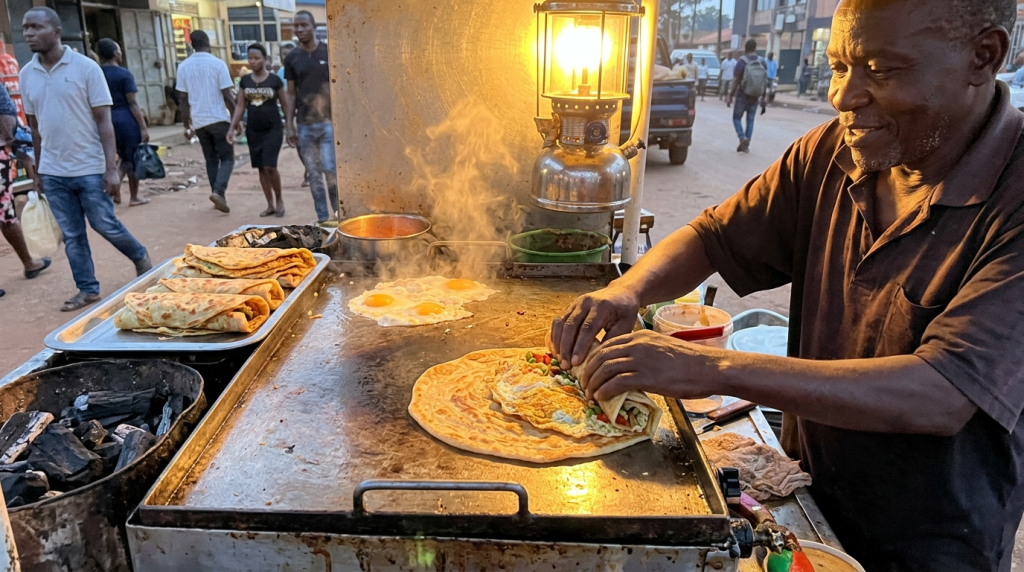
By Charles Lubega | Senior Food Writer & Cultural Guide, Travel Giants Uganda 6 Years Eating Across Uganda | Vendor Friend to Generations of Cooks | Self-Appointed Rolex Connoisseur The Explicit Answer: What You’ll Taste in This Guide Ugandan food doesn’t announce itself with Michelin stars or white tablecloths. It whispers from roadside rolex stands, from smoky fish joints along Lake Victoria, from grandmothers stirring groundnut stew in cast-iron pots. After 6 years of eating across this country—from the Karamoja plains to the Mount Elgon foothills—I’ve learned that the best meals aren’t found in tourist hotels. They’re found where locals eat. This map leads you there. This guide reveals 12 essential Ugandan dishes, exactly where to find them, and the local vendors who’ve perfected them over generations. You’ll learn what to order, how to eat it (etiquette matters), and the stories behind each dish that make it taste even better. Quick Overview of the 12 Dishes Dish Region Best For Rolex Kampala (nationwide) Breakfast, late-night, street food lovers Luombo Central Uganda (Buganda) Hand-food enthusiasts, ceremonial meals Muchomo Northern Uganda (nationwide) Meat lovers, evening grazing Malewa Eastern Uganda (Mount Elgon) Adventurous eaters, smoky flavors Eshabwe Western Uganda (Ankole) Rich, creamy sauce lovers Groundnut Stew Nationwide Comfort food seekers Nsenene Central Uganda (seasonal) Adventurous eaters, seasonal delicacies Fresh Nile Perch Lake Victoria shoreline Lakeside dining, fresh fish Matoke Nationwide Starch lovers, everyday meals Posho and Beans Nationwide Budget travelers, simple pleasures Luwombo Central Uganda (Buganda) Celebration food, special occasions Waragi and Tonto Nationwide (rural for tonto) Adventurous drinkers, social experiences The deeper truth: Every dish tells a story—of migration, of tradition, of survival. Eat with curiosity, and you’ll leave with more than a full stomach. You’ll leave with understanding. I’ve shared meals with grandmothers in villages without electricity, with fishermen at dawn on Lake Victoria, with street vendors who’ve been serving the same corner for 6 years. Let me introduce you to the tastes that define Uganda. The Philosophy – Why Eat Like a Local? Gist: Before we dive into the 12 dishes, you need to understand why eating local matters—and how to do it right. Three Reasons to Eat Like a Local 1. The Food Is Better Hotel buffets serve food that’s been sitting for hours. Street food is made fresh, to order, with love and attention. 2. The Stories Are Richer Every vendor has a story—how they learned their craft, where the recipe came from, why they add that secret ingredient. 3. Your Money Goes Further Paying a local vendor directly supports families, not corporations. Your shilling has more impact. The Golden Rules of Eating Local Follow the crowd: If locals are lining up, the food is good. Watch before you order: See what others are getting, how they eat it. Be polite: Greet the vendor, ask questions, show appreciation. Carry small bills: Not every vendor has change for large notes. Trust your gut: If a place looks clean and busy, it’s probably fine. The Honest Truth: You will get sick of hotel buffets by Day 3. Your first rolex from a roadside stall will be the meal you remember forever. Trust the locals. They know what’s good. Dish #1 – Rolex: Kampala’s Gift to the World Gist: Rolex has nothing to do with watches. It’s a contraction of “rolled eggs”—a chapati wrapped around an omelet, often with vegetables. It’s Uganda’s unofficial national street food, and everyone has an opinion on where to find the best one. Quick Facts Factor Details Dish Name Rolex (rolled eggs) Region Nationwide, but Kampala is the heartland Main Ingredients Chapati, eggs, onions, tomatoes, cabbage (optional: avocado, meat) When to Eat Any time, but especially breakfast and late night Price 2,000-5,000 UGX ($0.50-1.50 USD) The Experience You’ll approach a rolex stand—often a simple cart with a hot griddle, a pile of chapatis, and a bowl of beaten eggs. The vendor will ask what you want: just eggs? with vegetables? with meat? Watch as they pour the egg mixture onto the griddle, scatter onions and tomatoes, and cook it to a perfect golden disk. Then comes the rolling: the chapati is laid flat, the omelet placed on top, and the whole thing rolled into a cylinder, wrapped in paper, and handed to you. It’s hot, slightly greasy, and absolutely perfect. Where to Find It (Local Vendor Spotlights) Kampala: Wandegeya Rolex Specialists Near Makerere University, a cluster of vendors has been serving students for decades. Look for the busiest stall—that’s where the locals go. Ask for “full” (with vegetables) and add avocado if you’re feeling fancy. Jinja: Main Street Night Vendors After dark, Jinja’s main street transforms into a rolex paradise. The vendors here are known for their spicy versions—ask for “with chili” if you dare. How to Eat It Unwrap slightly, eat from one end like a burrito Don’t be afraid of the grease—it’s part of the experience Pair with a strong cup of Ugandan tea (chai) for the ultimate breakfast Insider Tip The best rolex is the one you watch being made. Chat with the vendor. Ask how long they’ve been at it. Every rolex maker has a story—and they’ll share it if you show interest. Dish #2 – Luombo: Bundles of Flavor Gist: Luombo is steamed plantain and meat, wrapped in banana leaves and cooked slowly over fire. It’s not just a dish—it’s a ceremony. The unwrapping releases aromas that will haunt you. Quick Facts Factor Details Dish Name Luombo (also spelled luwombo) Region Central Uganda (Buganda kingdom) Main Ingredients Plantains, meat (beef, goat, or chicken), peanuts, vegetables When to Eat Lunch or dinner, special occasions Price 10,000-20,000 UGX ($3-5 USD) The Experience Luombo is cooked in banana leaves—each bundle a complete meal. The leaves trap steam, infusing the food with a subtle, smoky flavor. When the bundle is opened at your table, the aroma is overwhelming: peanuts, meat, plantains, and something earthy you can’t quite place. Where to Find It (Local Vendor Spotlights) Kampala: Ekyombo Restaurant Tucked away in a Kampala side street, this family-run spot serves luombo the way it’s been
Beyond the Gorillas: An Authentic Local’s Guide to 8 Ugandan Cultural Experiences Most Tourists Miss
By Charles Lubega | Senior Cultural Guide, Travel Giants Uganda 6 Years Connecting Travelers with Uganda’s Living Cultures | Karamojong Elder’s Adopted Son | Batwa Trust Board Member The Explicit Answer: What You’ll Discover in This Guide The gorillas will change you. But Uganda—the real Uganda, the one most tourists never see—will stay with you longer. After 6 years of guiding travelers beyond the national parks, I’ve learned that the moments people carry home aren’t always the wildlife sightings. They’re the unexpected invitations: a Karamojong elder showing you how to throw a spear, a Batwa grandmother teaching you to forage like her ancestors, a fisherman on Lake Victoria inviting you into his home for a meal of fresh tilapia. This guide reveals 8 authentic cultural experiences most tourists miss—not performances staged for visitors, but genuine invitations into Ugandan life. You’ll learn where to go, who to ask for, what to expect, and exactly how to show respect as a guest. Quick Overview of the 8 Experiences Experience Location Best For Karamojong Manyatta Visit Kidepo area Warriors, cattle culture, remote adventure Batwa Pygmy Experience Bwindi area Forest survival skills, indigenous history Buganda Kingdom Royal Tour Kampala Kings, clans, living history Lake Victoria Fishing Village Entebbe/Jinja Dawn on the lake, fishermen’s lives Mbale Coffee Ceremony Mount Elgon Coffee lovers, traditional rituals Tooro Palace Visit Fort Portal Royal history, personal stories Nile Canoe Building Jinja Ancient crafts, disappearing skills Kampala Food Market Tour Kampala Culinary chaos, local flavors The deeper truth: These aren’t performances. They’re real life. You’re not watching—you’re participating. And if you show respect, you’ll leave with more than photos. You’ll leave with stories the guidebooks don’t tell. I’ve sat with Karamojong elders, shared meals with fishermen, and roasted coffee with Bagisu families. The guides I work with are my friends, not employees. Let me introduce you to the Uganda that lives beyond the safari vehicle. The Philosophy – What Makes an Experience “Authentic”? Gist: Before we dive into the 8 experiences, you need to understand what makes an encounter genuine—and how to be a guest who’s welcome back. The Three Pillars of Authentic Cultural Tourism 1. Mutual Respect You’re not there to observe like a specimen. You’re there to connect with fellow humans. Greet elders first. Accept offered food. Ask permission before photos. 2. Economic Justice Your presence should benefit the community directly. These experiences are not free—but your money should go to the people, not intermediaries. 3. Preservation, Not Performance The best cultural experiences aren’t staged. They’re real life that you’re invited to join. You’re not watching a show; you’re stepping into someone’s day. The Honest Truth: If it feels like a performance, it probably is. The experiences in this guide are the opposite—they’re invitations. Treat them as such, and you’ll be welcomed back. [IMAGE PLACEMENT 1: Hero shot of Karamojong warrior in traditional dress, spear, authentic expression, golden light. Caption: “Beyond the gorillas: Uganda’s cultures are as diverse as its landscapes. These 8 experiences will take you deeper.”] Experience #1 – Karamojong Manyatta Visit: Warriors of the Northeast Gist: The Karamojong are Uganda’s last remaining semi-nomadic pastoralists. In the remote northeast, they still live in manyattas (homesteads), tend cattle, and carry spears. Visiting them isn’t tourism—it’s an encounter with a way of life that has all but disappeared. Quick Facts Factor Details Location Karamoja sub-region, near Kidepo Valley National Park Best Time Dry season (December-February, June-September) Duration Half-day to full-day Cultural Context Semi-nomadic pastoralists, age-set system, cattle culture Access Requires 4WD and local guide (essential) The Experience You’ll drive into the Karamoja region—a landscape of acacia-dotted plains and rocky outcrops. Your guide will introduce you to the elder of a manyatta, who will decide whether to welcome you. If accepted, you’ll enter the homestead: a circle of huts made from mud, dung, and grass, surrounding a cattle kraal. The Karamojong may invite you to sit with them, share stories (through your guide), watch the warriors demonstrate spear-throwing, or simply observe daily life—women milking cows, children playing, elders discussing community matters. What Makes It Authentic No set “performance”—you experience real daily life Interaction depends on the community’s comfort Your visit provides direct economic support Cultural Protocols Dress modestly (long pants/skirts, covered shoulders) Wait to be invited before entering Ask permission before taking photos Accept offered food or drink (it’s rude to refuse) Greet elders first Insider Tip Combine this with a Kidepo Valley safari. The Karamojong have lived alongside wildlife for centuries—they can tell you things about lions and elephants that no guidebook knows. Experience #2 – Batwa Pygmy Experience: The First People of the Forest Gist: The Batwa were the original inhabitants of Bwindi Impenetrable Forest. They lived there for millennia, hunting, gathering, and worshiping in the forest they considered home. When Bwindi became a national park to protect the gorillas, the Batwa were displaced. Today, they offer visitors a glimpse into the world they lost. Quick Facts Factor Details Location Near Bwindi Impenetrable National Park (Mgahinga area) Best Time Year-round (combine with gorilla trekking) Duration 2-4 hours Cultural Context Indigenous forest dwellers, hunter-gatherers Access Easy (near gorilla trekking trailheads) The Experience Led by Batwa elders, you’ll walk a forest trail that was once their home. They’ll show you how they built shelters from leaves, which plants healed which ailments, how they hunted small game with bows and arrows, and which trees they considered sacred. They’ll sing songs passed down through generations—songs the forest taught them. They’ll demonstrate fire-making with sticks. And they’ll share stories of a life that no longer exists, except in their memories. What Makes It Authentic Led by actual Batwa elders, not actors The forest was literally their home Proceeds support Batwa communities directly Cultural Protocols Listen more than you speak This is a story of loss—be respectful Buy crafts directly from the makers Don’t bargain (these communities have very little) [IMAGE PLACEMENT 2: Batwa elder demonstrating fire-making in the forest, genuine concentration. Caption: “The Batwa lived in Bwindi for millennia. Today, they share the forest they
